ERPE Excerpts 3.27.25 TARIFFS

Bi-MONTHLY MARKET ANALYSIS &

ECONOMIC UPDATES

March 27, 2025

2025 Word of the Year…

TARIFFS

Tariff news has almost single handedly moved markets on a seemingly daily basis so far this year. The on-again, off-again and fast approaching possible tougher tariff talks on April 2 “Liberation Day” have created, in a word, uncertainty. A lot of it. Speaking of words, the 2025 word of the year (if there is such a thing) will likely be “Tariffs”. Just yesterday afternoon President Donald Trump provided his latest tough talk on tariffs. At the press conference he signed an executive order unveiling a new slate of 25% tariffs on all imports of fully-assembled automobiles. Like it or not, we all should gain a better understanding of tariffs. As I often emphasize, keeping proper perspective is necessary to be an effective investor. Here is a brief overview on what tariffs are and some history. Ultimately, we need perspective on how they may impact investment markets and the U.S. economy.

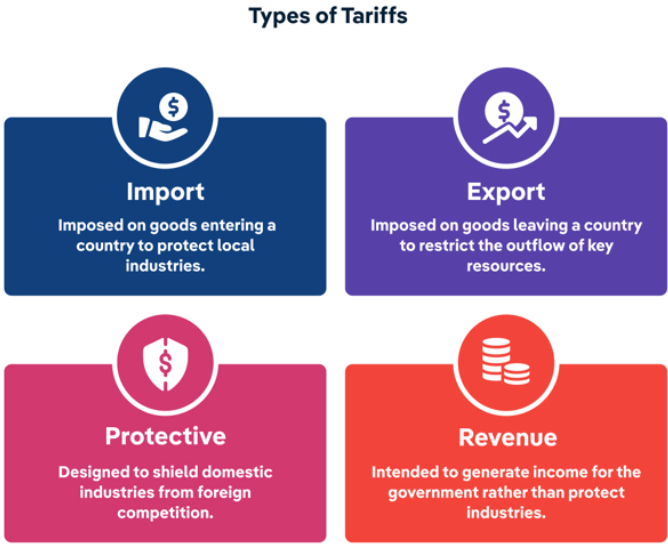
Tariffs are essentially taxes imposed on goods as they cross international borders. They play a crucial role in trade policy, serving to either protect domestic industries from foreign competition or to raise government revenue. By making imported goods more expensive, tariffs can encourage consumers to buy domestically produced alternatives. However, they also have the potential to raise consumer prices and disrupt supply chains.

The History of Tariffs and Their Impact on the U.S. Economy

Tariffs have been a critical component of U.S. trade policy since the nation’s founding. They serve as taxes on imported goods, aimed at protecting domestic industries, generating government revenue, and influencing economic behavior. Understanding the historical context and effects of tariffs can provide valuable insights for high-net-worth individuals regarding potential impacts on investments and the broader economy.

Early History and Purpose of Tariffs

The U.S. Constitution grants Congress the power to impose tariffs, a tool which was initially used to fund the federal government and protect emerging industries. The Tariff of 1789 marked the first major legislative use of tariffs, primarily intended to generate revenue. Over the 19th century, tariffs evolved into protective measures that helped developing American industries compete against established foreign competitors.

The Role of Tariffs in Economic Policy

Throughout history, tariffs have fluctuated in response to global economic conditions and domestic priorities. Major tariff acts, such as the Tariff of 1828 (the “Tariff of Abominations”) and the Smoot-Hawley Tariff of 1930, showed the potential for tariffs to spark trade wars and economic downturns. The latter is often credited with intensifying the Great Depression by stifling international trade. Tariffs saw a decline mid-20th century as the U.S. shifted towards free trade to stimulate economic growth. The General Agreement on Tariffs and Trade (GATT), established in 1947, aimed to reduce tariffs and promote international trade, leading to significant economic expansion.

Recent Trends and Modern Implications

In recent years, especially starting in 2018, tariffs have resurfaced as a significant part of U.S. trade policy, notably during the trade tensions between the U.S. and China (and Mexico, Canada and Europe). The imposition of tariffs on goods from China was aimed at addressing trade imbalances and protecting intellectual property rights, but it has also led to retaliatory tariffs, which disrupted global supply chains.

For investors, the implications of tariffs can be sizeable. Tariffs can elevate costs for companies reliant on imported materials, affecting their profitability and stock prices. Additionally, consumers may face higher prices on goods subjected to tariffs, potentially leading to reduced spending and slower economic growth. These, for example, are the very issues GM is leaning into as I write this.

Strategic Considerations for High-Net-Worth Individuals

Understanding the potential impact of tariffs on investments and the economy is crucial for investment strategies. Investors should consider:

  • Sector Exposure: Industries such as manufacturing, agriculture, and technology may respond differently to tariff changes. Diversification across sectors can mitigate risks. There has been Trump tariff talks on a wide of products since the Campaign Trail – ranging from steel and cars, to Champagne and pharmaceuticals.
  • Global Supply Chains: Some companies that have adaptive supply chain strategies, enabling them to navigate tariff impacts effectively.
  • Economic Indicators: Stay informed. Keep perspective and a long term view. Monitoring macroeconomic indicators such as inflation, consumer spending, and trade balances can signal broader economic conditions.

The history of tariffs in the U.S. reveals their complex role in shaping economic policies and impacting markets. The Smoot-Hawley Tariffs is considered one of the most catastrophic congressional Acts in history, though it was well intended. By understanding historical precedents and current trends, investors can be better positioned for both challenges and opportunities that tariffs present. So, with “Liberation Day” on April 2, we will gain more insight on the scope of the developing trade war. Let’s hope it is not a repeat of the 1930 “Mother of all trade wars”.

TAKING PERSPECTIVE…

Proper Perspective:  In our hectic and often hard to comprehend world, it is very easy to lose perspective. You may agree it is sometimes difficult to see the big picture. The media often doesn’t help with this, but unfortunately instead encourages us to see things in a most negative light. Here is hopefully a pause to gain positive perspective.

Famous Quote On This Day:  “We must dare to think “unthinkable” thoughts.”

~~ James W. Fulbright, 1964

What Happened On this Day March 27, 1846 – Mexican forces lay siege for Fort Texas, launching the Mexican-American War.

MARKET ANALYSIS

INDICATORS OF INTEREST:

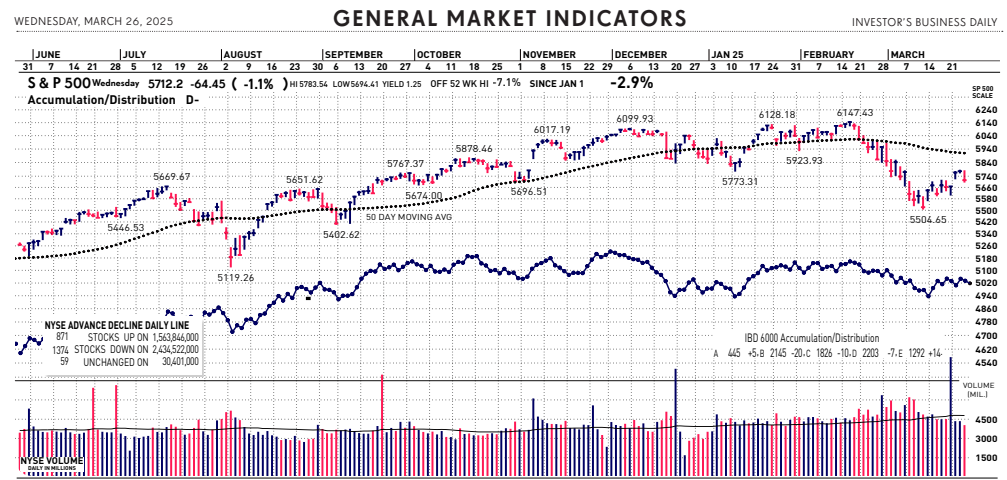
  • Market’s Current Signal: Market in Correction.  Analysis of the stock market over 130 years of history shows we can view it in terms of three stages – market in uptrend, uptrend under pressure and market correction.  Since the 1880’s, this perspective has led to investment out-performance relative to market indexes. This is due to trend analysis which determines risk reducing, return enhancing market entry and exit points. The U.S. stock market’s current signal indicates the market is in correction mode. That officially happened March 13.

The Stock Market Trend: Market in Correction. Just days after the major market indexes closed at new all-time record highs on February 19, the market’s trend signal weakened from Confirmed Uptrend to Uptrend Under Pressure the 21st and reiterated on the 24th. The next weaker signal would be Market in Correction. That would be a 10% drop from the high made February 19.. That happened. All recent rally attempts have failed. Bullish market action late last Friday looked promising. It nearly sparked a follow-through, confirmed to rally – but again it reversed lower.

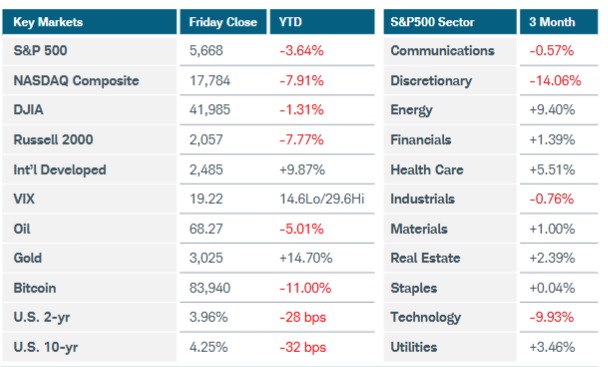
Here are key market levels as of Monday, March 24.

Recapping Last Week

U.S. equity indices stabilized in choppy trading after the Federal Reserve kept interest rates steady while downgrading the economic outlook. The S&P500, Nasdaq Composite, and Russell 2000 indices all posted marginal gains. S&P500 sector performance was narrowly positive, boosted by outperformance from energy and financials. Crude oil prices rose 1.5% after Israel launched airstrikes in Gaza, threatening to end a two-month ceasefire and heightening Middle East tensions. Additionally, OPEC+ announced production cuts exceeding the planned hikes that are scheduled to go into effect in April—this in response to member nations who are producing above agreed levels. Gold futures advanced to another weekly record close at $3,025 per ounce. U.S. Treasury yields tumbled after the Fed’s Summary of Economic Projections revealed an upward revision to inflation expectations along with slower GDP growth. Core PCE is forecasted to rise by 2.8% this year—a notable bump from the prior 2.5% estimate—while the economy is projected to grow by 1.7% in 2025 and 1.8% for each of the next two years. The Fed also announced plans to slow the pace of its Quantitative Tightening program. Median “dot plot” projections still imply two rate cuts for this year and next, but a number of FOMC members revised their year-end federal funds rate forecast for 2025 and 2026 higher than it had been. Although Chair Powell noted that the economy remains strong and the labor market balanced, the Fed’s forecasts reflected rising uncertainty due to tariffs and other factors. In other news, U.S. retail sales increased 0.2% in February, a solid pace, albeit slower than the prior month. Single-family housing starts rebounded last month, but permits for future construction fell as rising construction costs and labor shortages loomed. Existing home sales rose even as tight supply kept upward pressure on prices.

In international markets, Germany’s parliament approved plans for the new government’s massive fiscal expansion to shore up infrastructure and defense investment, although some economists cautioned that labor shortages and bureaucratic red tape may delay the positive ripple effects. The Bank of England kept interest rates unchanged at 4.5%, with one of the nine committee members favoring a quarter-point reduction. The Bank of Japan also held steady and pointed to upcoming data as crucial for the timing and pace of further rate hikes. Japan’s core CPI was stronger than expected in February despite the resumption of government energy subsidies. Finally, China’s retail sales rose 4% in the first two months of the year, in line with forecasts, while industrial production outpaced expectations at +5.9%. The country’s policymakers announced plans to boost consumption but provided few details.

Current View

The specter of a trade war, concerns on how it could hit the economy, and lingering worries on inflation packed yet another one-two punch on stocks yesterday. The tech-stock-heavy Nasdaq suffered the brunt of the sell-off. Yesterday was the Nasdaq’s worst single-day decline since March 10. That happened to be the 25th anniversary of the dot-com bubble’s top, which took place on March 10, 2000. The negative market action threw a blanket drenched in ice water on the positive action seen just two days earlier. Specifically, Monday’s 2.3% advance by the Nasdaq carried the spirit of a Day 9 follow-through day amid the market’s current new rally attempt. But after yesterday’s bearish action, the composite index fell well below the low of Monday’s price. In fact, the Nasdaq has now chalked up six such sell-offs of at least 2% or more so far in 2025. That only happened 12 times in all of 2024.

Tariff Watch 2025 really ramped up yesterday. He signed an executive order levying a 25% tariff on imported cars and some car parts. The tariff talks du jour when I wrote my last ERPE Excerpts, March 13 was on alcohol products. I wrote, “Today Trump threatened to slap tariffs of up to 200% on wine and spirits from Europe, which skew the latest data that indicate inflation is not accelerating. Not surprisingly, Europe-based alcohol makers fell.” Another day, more tariff concerns. Now the markets anticipate “Liberation Day” April 2.

  • Industry Group Strength:  BEARISH. As of yesterday, 72 out the 127 groups I monitor are up year-to-date. 79 groups are down for the year.
  • New Highs vs. New Lows:  BEARISH. In yesterday’s session, there were 90 new 52-week highs and 147 new 52-week lows.
  • Dow Dividend Yield:  BEARISH. The current yield for the Dow Jones Industrial Average is 1.86%. The 10-year Treasury now 4.37%.
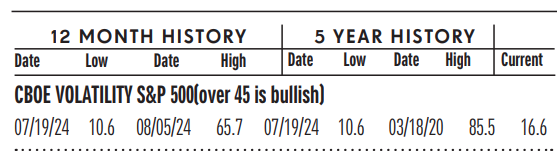
  • Volatility Index:  NEUTRAL. Volatility has been volatile. The “VIX” is now 19, down from 27 as two weeks ago. The index is also known as the “Fear Index.” It is considered a contrarian indicator and therefore viewed as bullish as it rises indicating investors are becoming more fearful. The VIX:
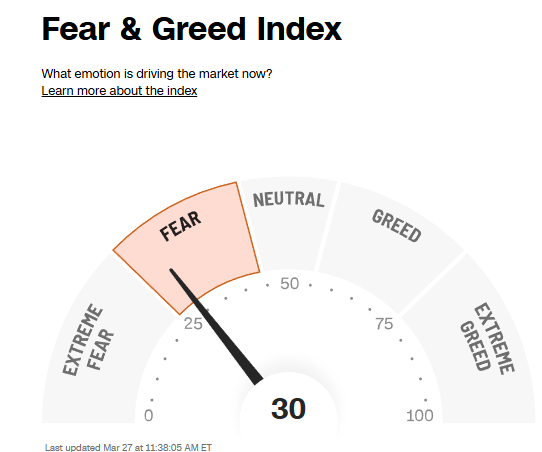
  • Fear / Greed Index: BULLISH.  Investors are driven by two emotions: fear and greed. Too much fear can create a condition of oversold/ undervalued stock prices. Too much greed can result in overbought/overvalued stock prices. The AAII Investor Sentiment Index is now neutral.   BE FEARFUL WHEN OTHERS ARE GREEDY. At 30, the Fear & Greed Index is up from 18 two weeks ago.

CLICK VIDEO FOR MORE ON THE “FEAR & GREED INDEX”

How CNNMoney’s Fear & Greed Index works

  • Bull / Bear Barometer:  NEUTRAL. This secondary market indicator should also be viewed with a contrarian perspective. As of yesterday, according to the latest survey of stock market newsletter writers by Investor’s Intelligence, the bullish tally is 30.5% up from 27.6% 2 weeks ago. The bears are 28.8% , down from 34.5% 2 weeks ago. Consider this a contrarian indicator because the crowd is often wrong at market tops and bottoms. In other words, extreme bullishness has been seen near several market tops in the past, while extreme bearishness has been seen at market bottoms.
  • Put / Call Ratio: NEUTRAL. The ratio of put-to-call options is .96, up from 1.34 2 weeks ago. The put-call ratio tracks the mood of what options investors are doing, not just saying. They typically buy puts if they think a stock will decline and calls if they think it will rise. If they’re buying lots of puts, they see the market declining. And if they’re loading up on calls, they’re generally bullish. Historically, market bottoms occurred when the reading spikes to 1.2 or more. Market tops are often made when the reading is 0.6 or less. Note how reliable this is with respect to the February record low coinciding with the market high. Keep in mind this is also a contrarian indicator.

ECONOMIC UPDATES

Global Economic Indicators & Analysis:

POSITIVE INDICATORS

Jobless Claims Down:  Initial jobless claims excluding federal workers fell by 1,000 to 224,000 in the last week, the government said today. The number of jobless workers collecting unemployment benefits declined by 25,000 to 1.86 million, based on seasonally adjusted figures. These so-called continuing claims have risen gradually over the past two years, because it’s taking longer for people who lose a job to find another. About 224,000 people who lost their jobs applied last week for unemployment benefits, a very low number that suggests the U.S. labor market is still in good shape even as trade wars reverberate through the economy.

Industrial Output Up: Industrial production rose 0.7% in February, the Federal Reserve reported last Tuesday. The gain was above economists’ expectations for a 0.3% rise, according to a survey by the Wall Street Journal. Manufacturing, which makes up three-quarters of total production, jumped 0.9% in February, after a 0.1% rise in the prior month. Motor vehicle and parts output rose 8.5% in February after a 5.3% drop in the prior month. Excluding motor vehicles, industrial output rose 0.4%. Utilities output fell 2.5% in February after a strong 6.1% gain in the prior month that was due to severe winter storms. Mining output rebounded to a 2.8% gain after a sharp 3.2% drop in January. Big picture, economists said the data should ease concerns that a recession was imminent.

Retail Sales Up, barely: Sales at U.S. retailers rose a scant 0.2% last month, the government said last week, and showed little rebound after a sharp decline in January. The increase also fell well short of the 0.6% forecast of economists polled by The Wall Street Journal. Yet another figure in the report known as the “control group” that feeds directly into gross domestic product jumped 1%. That category excludes autos, gasoline, building materials and restaurants. The rebound in the so-called control group suggests retail sales won’t be a big drag on first-quarter GDP as it might have seemed a month ago. Investors cheered the news, driving stocks higher in last Monday’s trades.

Durable-Goods Up: Orders for long-lasting durable goods rose almost 1% in February as U.S. manufacturers rushed to procure supplies ahead of the Trump administration’s tariffs on foreign steel and aluminum. Orders for primary metals and appliances surged for the second month in a row, the government’s report on durable goods showed. These are big-ticket products meant to last at least three years. Manufacturers were hoping for a recovery this year after a prolonged slump, but White House trade fights have raised the specter of rising costs. Companies have responded by speeding up orders before the tariffs took effect in March — causing metal producers to raise prices. Aside from strong demand for metals, orders for new autos and military aircraft also showed strength. U.S. carmakers have also tried to beat pending Trump White House tariffs on parts and vehicles from Mexico and Canada. The new administration also plans to build more defense fighters. A big reason durable-goods orders did not decrease as expected was because of a smaller-than-expected decline in orders for passenger planes.

New Housing Up but Slowing: Construction of new homes rose 11.2% in February as builders coming off a harsh winter ramped up new projects. Although home builders saw a small increase in the pace of sales of newly built homes in February, they remain worried about home buyers pulling back in the coming months — so they’re increasing incentives to keep buyers interested. Building permits, a sign of future construction, fell 1.2% from the previous month to a 1.46 million rate in February. Despite the jump in starts in February, economists expect builders to pull back on new-home construction in the coming months. And that’s bad news for the housing market.

Existing Home Sales Up: Sales of existing homes rose in February, as some buyers — particularly those with higher incomes — are keeping the upper end of the market alive and well. All-cash buyers made up 32% of sales. The share of individual investors or second-home buyers was 16%. Thirty-one percent of homes were sold to first-time home buyers.  Only 7.6% of homes sold in the U.S. were over $1 million, while 18% of homes sold were between $500,000 and $750,000 and about 45% of homes sold were between $250,000 and $500,000. Home sales broadly rose 4.2% in February to a 4.26 million pace. That’s the number of homes that would be sold over an entire year if sales took place at the same rate in every month as they did in February.

WEAK INDICATORS

LEI Down:  Leading Economic Indicators for the U.S. declined by 0.3% in February 2025 to 101.1, after a 0.2% decline (revised from –0.3%) in January. Overall, the LEI fell by 1.0% in the six-month period ending February 2025, less than half of its rate of decline of –2.1% over the previous six months (February–August 2024).

Consumer Confidence Down: This economic indicator sums up the true state of where people and markets are today…. Consumers and businesses have grown very anxious about President Donald Trump’s trade wars — and they have increasing doubts about the future of the economy if the White House stays on the current path. The latest signal of angst: The long-running survey of consumer confidence fell to a more than four-year low of 92.9 this month, from 100.1 in February, the Conference Board said Tuesday. That’s the fourth decline in a row and the lowest reading since January 2021. Further, consumer expectations about the future sagged to a 12-year low. Confidence among companies and households had surged to a 16-month high after Trump’s election in November on optimism about tax cuts, deregulation and a business-friendly White House. Yet the president’s tariffs have unwound the optimism, renewing worries about inflation and even a weakening economy. The stock market has also taken a beating, although it has partially recovered this week. The so-called expectations index — which measures how people think the economy will look six months from now — tumbled to 65.2 from 74.8. That’s the weakest reading since 2013. A sustained reading below 80 tends to signal a recession.

Empire State Index Down: Manufacturing activity contracted in New York State, according to the March survey. The general business conditions index dropped twenty-six points to -20.0. The new orders index fell twenty-six points to -14.9, and the shipments index fell twenty-three points to -8.5, indicating that both orders and shipments declined after increasing last month. Unfilled orders held steady. The inventories index moved up five points to 13.3, its highest reading in more than two years, signaling that business inventories continued to expand. The delivery times index came in at 1.0, and the supply availability index was -1.0, suggesting delivery times and supply availability were little changed.

IPI Up:  Here’s evidence of tariff triggered inflation. The cost of imports rose faster than usual in February, perhaps a result of U.S. companies rushing to bring in foreign goods ahead of President Trump’s tariffs. Import prices increased 0.4% in February for the second month in a row, the government said last Tuesday. However, if energy is omitted, import prices rose 0.3% in the month. Economists are watching import prices to try to gauge the effect of new Trump tariffs. When Trump raised tariffs in 2018, import prices rose faster for several months, but soon settled down. The latest Trump tariffs could be a lot steeper, though, so it’s unclear how import prices would change. By and large, imports have not been a big contributor to U.S. inflation. Import prices have risen just 2% in the past 12 months. One year ago, however, import prices were negative.

Call me if you have any questions. I am always happy to help!

John J. Gardner, CFP®, CPM®.

Blackhawk Wealth Advisors, Inc.

3860 Blackhawk Rd. Ste. 160 Danville, CA. 94506

Phone: 888-985-PLAN · Email: jg@blackhawkwealthadvisors.com

BLACKHAWKWEALTHADVISORS.COM

For my Market Monthly podcast, click on the link below. I provide a review of global stock market highlights over past month and preview of the month ahead. Forward insights and perspectives are based on current financial market and economic trends with an emphasis on relevant developments in various areas from Fed policy to company earnings announcements.

810c9060-6bc9-4e20-948f-60bee7c1b0be image
dc6d6594-dfce-48b0-8d69-3a27db12748d image
7d2eabf6-51c8-425f-b667-128ed7bc0dd2 image

Blackhawk Wealth Advisors is the parent corporation of Equity Research & Portfolio Evaluation and Blackhawk Asset Management. It’s Chief Investment Officer is John J. Gardner. John is a Certified Financial Planner (CFP®) and Certified Portfolio Manager (CPM®). As an AIF®, John is also an Accredited Investment Fiduciary.

CUSTOMIZED. STRATEGIC. DYNAMIC.