|
Schwab IMPACT 2026
Celebrating Independence
|
|
|
Charles Schwab, through its Schwab Advisor Services division, welcomed thousands of independent registered investment advisors (RIAs) to Boston last week for its 36th annual IMPACT® conference. IMPACT is the nation’s largest and longest-running gathering of independent advisors. I am glad I attended as IMPACT 2026 highlighted the custodian’s focus on AI and other developments it has in place to support advisor growth and their commitment to the future of independent advice. Schwab Advisor Services remains steadfast that independence is at the center of everything it does. Schwab’s IMPACT 2026’s theme was “A Celebration of Independence”. As I have returned from another Schwab IMPACT conference, I want to share the experience with you. I learned a lot, met some interesting professional peers and got a big dose of why Schwab is the best custodian available to support investment advisors and safeguard client assets while remaining current with its offering of technologically enhanced investment and financial planning tools and resources.
|
|
|
|
 |
|
Inside and out the Boston Convention & Exhibition Center
|
|
|
|
Fresh Insights from Boston: Takeaways from Schwab IMPACT 2026
The core takeaway from Boston was clear: While market environments evolve and financial technology accelerates, the foundational value of disciplined, independent advice grounded in personal trust has never been higher. The theme of the event that I heard most loud and clear is Schwab’s embrace of AI as a tool to improve its effectiveness and efficiencies in its effort to support investment advisors and their clients. Specifically, Schwab announced its partnership and alliance with Anthropic to integrate “Claude” for investment advisors. This is undoubtedly the biggest development I will have experienced in my career dating back to 1984.
Stepping away from my routine and the daily market screens to collaborate with industry thought leaders, technology pioneers, and market strategists was a priceless investment. In essence, it ensures that Blackhawk Wealth Advisors stays at the leading edge of institutional portfolio management, security practices, and long-term wealth preservation. A nice bonus was the weather in Boston was great and the city exuded a spirit of friendly hospitality and kindness.
Why Our Choice of Custodian Matters Directly to You
As an independent fiduciary advisory firm, I have complete freedom to select the institutional partners that custody your accounts. My choice of Charles Schwab as our primary institutional custodian is intentional, structured around three core pillars:
- Uncompromising Security & Capital Scale:
If you are a client, your assets are safeguarded by one of the largest, most financially sound financial institutions in North America. Operating under strict regulatory oversight, Schwab provides institutional-grade trading execution, robust cybersecurity defense, and asset protection mechanisms—giving you maximum peace of mind regardless of market volatility.
- Enterprise Technology Built for Fiduciary Precision:
Schwab’s continued multi-billion-dollar investments in secure advisor technology streamlining account administration, digital processing, and backend integrations. This operational efficiency behind the scenes frees up my time to focus strictly on what matters most to you: high-touch portfolio management, risk mitigation, and personalized financial planning.
- Institutional Depth with Personalized Care:
Through Schwab’s institutional platform, our firm accesses specialized fixed-income desks, advanced tax-aware transition tools, and deep wealth planning resources. Investors with accounts custodied by Schwab receive the structural strength and broad capabilities of a global financial institution, seamlessly paired with the personal, localized attention of an independent wealth management firm such as Blackhawk Wealth Advisors.
Investing in education, and strategic partnerships is foundational to how we maintain a disciplined approach to protecting and growing client capital. As always, thank you to you clients for your continued trust. If you’re not and are seeking prudent investment advice, call me anytime.
Closing on a fun note, IMPACT 2026 included a few incredibly insightful keynote and expert guest speakers. For me the most impressive was a panel discussion steered by CNBC anchor Morgan Brennan. She hosted two astronauts from the Artemis II crew, Victor Glover and Jeremy Hansen. They shared their incredible experience in the recent lunar mission that took them over 250,000 miles beyond earth.
|
|
Here’s more on Schwab…
In its latest earnings report, Schwab announced record net new assets and earnings. 3Q net revenues reached a record $7.2 Billion, Up 17% Year-Over-Year.
Below are some key growth metrics.
|
|
|
Here’s a list of some impressive growth stats for Charles Schwab over the trailing 12 months:
Firm Size & Total Client Assets
• Total Client Assets: Reached about $13.4 trillion (up roughly 19% year-over-year depending on the exact month).
• Company Balance Sheet Assets: Total corporate assets stand at $517.27 billion as of Q3 2026, representing a 12.71% increase year-over-year.
• Core Net New Assets: Recorded $190.4 billion in core net new assets for Q3 2026 (up 38% YoY), with cumulative trailing net new asset inflows remaining strong.
Client Accounts & Growth
• Active Brokerage Accounts: Reached over 40 million active accounts, with over 1.2 million new brokerage accounts opened in Q3 alone.
• Banking Accounts: Total 2.4 million banking accounts.
• Workplace Plan Participant Accounts: Approximately 5.9 million participant accounts.
• Total Client Accounts: Across all categories, total client accounts stand at approximately 48.6 million.
|
|
|
Proper Perspective: In our hectic and often hard to comprehend world, it is very easy to lose perspective. You may agree it is sometimes difficult to see the big picture. The media often doesn’t help with this, but unfortunately instead encourages us to see things in a most negative light. Here is hopefully a pause to gain positive perspective.
|
|
|
Famous Quote For Today: “I have always fought for the right of people to be able to be treated equally in America.”
~~ John Kerry, 2003
Today in History – On this day in 1968,Winning a close election, Richard Nixon defeats Vice President Hubert Humphrey.
|
|
|
INDICATORS OF INTEREST:
- Market’s Current Signal: From Market in Correction.
Analysis of the stock market over 130 years of history shows we can view it in terms of three stages -market in uptrend, uptrend under pressure and market correction. Since the 1880’s, this perspective has led to investment out-performance relative to market indexes. This is due to trend analysis which determines risk reducing, return enhancing market entry and exit points.
With an uptick in market volatility in recent sessions, the market’s trend signals have flashed indication changes more frequently than normal. That volatility has heightened today. These big swings have quickly triggered a weakened trend to Market in Correction. The Nasdaq, for example, is now down nearly 12% from its October 6 closing high.
|
|
|
Here are key market levels as of Monday, November 2:
|
|
Recapping Last Week
Technology and energy markets diverged sharply this week, while the Federal Reserve’s steady hand proved less decisive than initially suggested. Equities opened on a constructive note Monday following news of Anthropic’s S-1 filing, but sentiment reversed by midweek as hyperscaler earnings from Alphabet, Amazon, and Intel reignited concerns over the scale of AI-related capital expenditure. This, in
turn, dragged the Nasdaq down as much as 2.8% on Friday. The selloff was broad enough to overwhelm a structural shift already underway in the market: correlation among the “Magnificent Seven” has fallen to its lowest point in a decade, indicating the decline of the single-basket trade that long defined the group. Apple was penalized in 2025 for lagging peers on AI spending and has more recently been rewarded for that same restraint—but even it was not spared in Friday’s selloff. This suggests the drawdown reflected a sector-wide repricing of AI-related growth and margin assumptions and not solely a verdict on company- specific capex decisions. Friday’s $6.3 billion hack of Binance represented the largest such breach on record, adding a significant security event to the week’s cryptocurrency-market backdrop. The FBI linked the attack to an operation based in North Korea, while Binance said it would absorb the financial impact of the stolen coins rather than pass the losses on to its users. Energy told a different story: Chevron and Exxon reached all-time highson strong refining profitability, as geopolitics drove WTI to join Brent above $100 per barrel Friday, as Ukraine has been responding to Russia’s attacks on their energy grid by striking Russian refining infrastructure. This, alongside the ongoing Iran conflict have added a persistent risk premium to crude, despite the U.S. administration’s efforts to ease domestic prices through direct negotiations with Russian producers. Wednesday’s 10-2 FOMC decision to hold rates steady added further texture. Chair Warsh acknowledged elevated inflation but noted the Fed is awaiting an “accumulation of more information” before acting further. He also signaled his intent to reduce the frequency of rate- decision meetings, though he didn’t specify a timeline. The initial reaction pushed the 10-year Treasury yield above 5%, but that move reversed later in the week as tech-driven risk aversion spurred a flight to safe-haven instruments, pulling yields back below the threshold. This round trip indicated that equity stress, rather than any shift in the policy outlook, was the dominant driver. Most major central banks followed a similar path, holding rates steady despite persistent global inflation pressures. This points to a coordinated preference for patience over preemptive action. Collectively, the week underscored a market increasingly attuned to the sustainability of AI capex and to geopolitically driven energy-supply risk, with rate-sensitive assets taking their cues more from equity risk appetite than from policy signals themselves.
Current View
The broad stock indexes roared yesterday following an overwhelming set of election victories for the Democratic Party, which won majorities in both houses of Congress. However, not all stocks were in rally mode. The biggest losers were shares of companies that would be hurt by the Democrats’ push to slow the buildout of artificial-intelligence infrastructure, like data centers. Yesterday’s euphoria following elections vanished. The selling pressure in all-things AI has carried over to today’s early market action. And how! Selling has spread to nearly all stock market segments. The Nasdaq is by far being hit the hardest, down over 5% as I write. It is the worst day for the tech-heavy index since April of 2025. The semiconductor stock index is has plunged over 35% in less than a month, it’s biggest plunge since the Covid Crash of March 2020. Today’s steep slide in the Nasdaq has sparked more fear of the Dot-Com bubble burst. History shows a 5% or greater one-day-fall in the Nasdaq is rare. On January 2, 2001 it collapsed 7.3% are widespread earnings for tech companies and internet startups were running out of cash.
With the market in correction, caution is the prudent course.
|
|
- Industry Group Strength: BULLISH. As of yesterday, 97 out the 145groups I monitor are up year-to-date. 48 are down.
- New Highs vs. New Lows: BULLISH. In yesterday’s session, there were 369 new 52-week highs and 235 new 52-week lows.
- Dow Dividend Yield: BEARISH. The current yield for the Dow Jones Industrial Average is 1.67%. The 10-year Treasury now 4.83%.
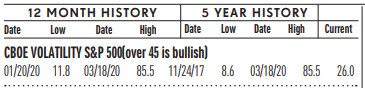
- Volatility Index: BULLISH. Volatility has been volatile. The “VIX” is now 28, it is up from 19 two weeks ago. The index is also known as the “Fear Index.” It is considered a contrarian indicator and therefore viewed as bullish as it rises indicating investors are becoming more fearful. The VIX:
|
|
- Fear / Greed Index: BULLISH. Investors are driven by two emotions: fear and greed. Too much fear can create a condition of oversold/ undervalued stock prices. Too much greed can result in overbought/overvalued stock prices. The AAII Investor Sentiment Index is now neutral. BE FEARFUL WHEN OTHERS ARE GREEDY. At 27, the Fear & Greed Index is down from 31 two weeks ago.
|
|
|
CLICK VIDEO FOR MORE ON THE “FEAR & GREED INDEX”
|
|
- Bull / Bear Barometer: NEUTRAL. This secondary market indicator should also be viewed with a contrarian perspective. As of yesterday, according to the latest survey of stock market newsletter writers by Investor’s Intelligence, the bullish tally is 42.6%, down from 49.1% two weeks ago. The bears are 18.5%, up from 16.7% two weeks ago. Consider this a contrarian indicator because the crowd is often wrong at market tops and bottoms. In other words, extreme bullishness has been seen near several market tops in the past, while extreme bearishness has been seen at market bottoms.
|
- Put / Call Ratio: NEUTRAL. The ratio of put-to-call options is .84, up from 0.67 two weeks ago. The put-call ratio tracks the mood of what options investors are doing, not just saying. They typically buy puts if they think a stock will decline and calls if they think it will rise. If they’re buying lots of puts, they see the market declining. And if they’re loading up on calls, they’re generally bullish. Historically, market bottoms occurred when the reading spikes to 1.2 or more. Market tops are often made when the reading is 0.6 or less. Note how reliable this is with respect to the February record low coinciding with the market high. Keep in mind this is also a contrarian indicator.
|
|
|
Global Economic Indicators & Analysis:
POSITIVE INDICATORS
Jobless Claims Down: Today the Labor Department said weekly initial jobless claims fell to 189,000 in the latest week, down from 194,000 last week. Claims were seen rising to 196,000, according to Econoday.
|
|
|
Factory Orders Up: New orders for US factory goods increased more than expected in September, boosted by bookings for aircraft and a range of other goods, government data showed on Tuesday. Factory orders rose 1.8% after an upwardly revised 0.3% gain in August, the Commerce Department’s Census Bureau said. Economists polled by Reuters had forecast orders surging 1.2% after a previously reported 0.1% gain in August.
|
|
|
Manufacturing Index Up: The ISM U.S. manufacturing PMI rose to a higher-than-expected 55.5 in October from 54.5 in September and 54.6 in August, according to data from the Institute for Supply Management. The October reading, above the 50 expansion-contraction threshold, indicated the U.S. manufacturing sector expanded for the 10th consecutive month and at the fastest pace since July. A reading of 54.7 for October had been expected in the Action Economics Forecast Survey. The latest manufacturing PMI was above a contractionary 48.8 in October 2025 and a low of 47.0 in October 2024, while remaining below a peak of 63.8 in March 2021.
|
|
GDP Up: Real gross domestic product (GDP) increased at an annual rate of 3.4% in the third quarter of 2026, according to the advance estimate released last Thursday by the U.S. Bureau of Economic Analysis (BEA). In the second quarter, real GDP increased 2.2%. The contributors to the increase in real GDP in the third quarter were increases in investment, consumer spending, and government spending that were partly offset by a decrease in exports. Imports, which are a subtraction in the calculation of GDP, increased.
|
|
WEAK INDICATORS
Service Sector Index Down: The U.S. ISM Services PMI declined to a lower-than-expected 54.5 in October from 54.9 in September and 55.4 in August, data from the Institute for Supply Management showed, indicating expansion in the services sector for the 28th straight month but at the slowest pace since July. The Action Economics Forecast Survey had expected 54.7 for October. The latest reading was above 52.0 in October 2025 and a low of 49.4 in June 2024, while remaining below its recent high of 56.1 in February and a record-high 67.5 in November 2021. The 12-month average was 54.3, pointing to continued growth in the U.S. services sector.
|
|
|
Call me if you have any questions. I am always happy to help!
John J. Gardner, CFP®, CPM®.
|
|
|
Blackhawk Wealth Advisors, Inc.
|
|
|
For my Quarterly Market Focus podcast, click on the link below. I provide a review of global stock market highlights over the past quarter and preview of the quarter ahead. Forward insights and perspectives are based on current financial market and economic trends with an emphasis on relevant developments in various areas from Fed policy to company earnings announcements.
|
|
Blackhawk Wealth Advisors is the parent corporation of Equity Research & Portfolio Evaluation and Blackhawk Asset Management. It’s Chief Investment Officer is John J. Gardner. John is a Certified Financial Planner (CFP®) and Certified Portfolio Manager (CPM®). As an AIF®, John is also an Accredited Investment Fiduciary. |
|
|