|
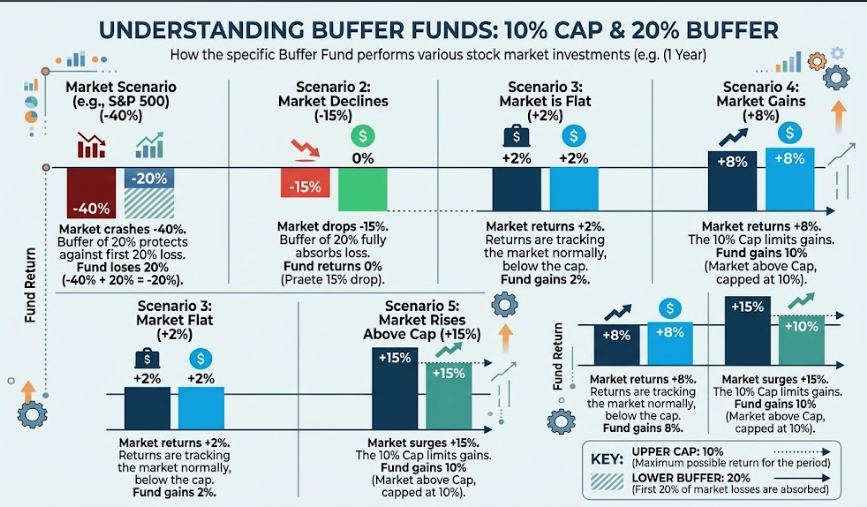
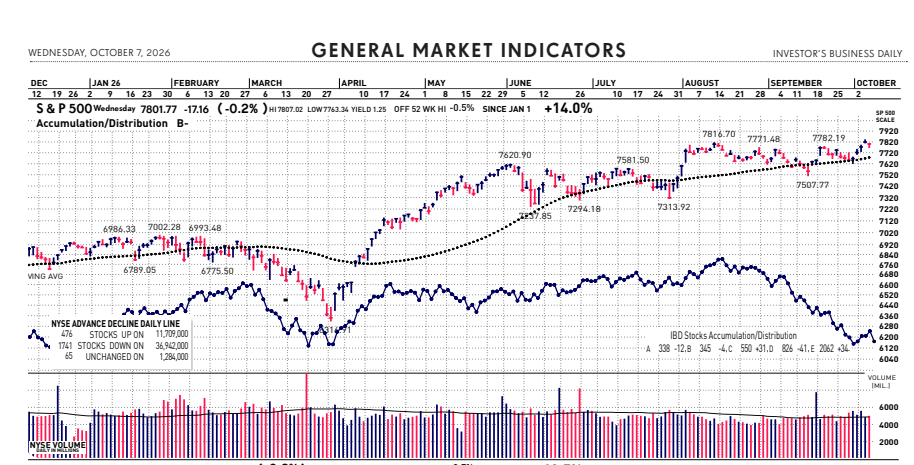
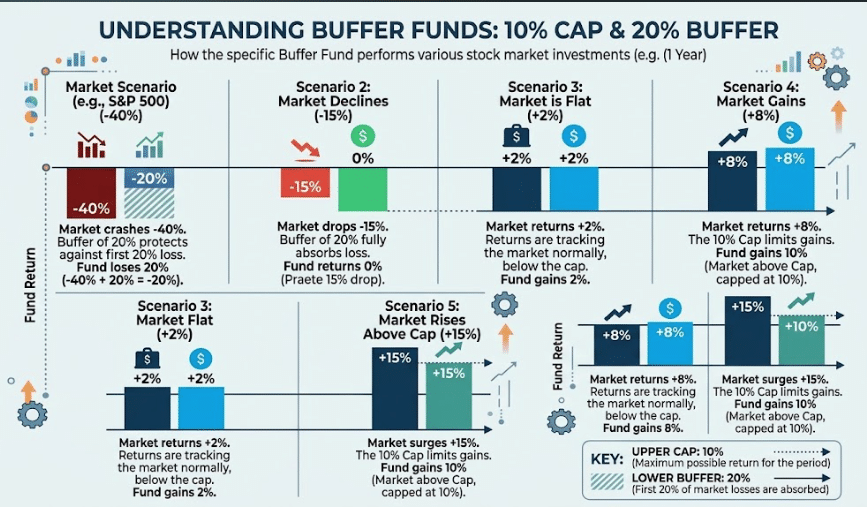
Revisiting Buffers is largely a function of current market conditions. The basic purpose of Buffer Funds is to balance principle protection and performance. That is a growing demand for many investors today. With the bench-mark bond yields at 20+ year highs, the S&P 500 at all-time highs, and a stock bull market near 4-years old, a balanced investment focused on risk mitigation is timely. Stated simply, Buffer’s seek to track the return of the S&P 500, or another stock index, up to a predetermined cap, while buffering investors against losses over the outcome period, typically one year. For example, a recent 1-year Buffer Fund provides a 20% protection (the “buffer”) and an upside max return of 10% (the “cap”). Again, I offered more on how Buffers work with my Excerpts July 18, 2024. Today, I wanted to offer some more insight as to how now may be an ideal time for both bond and stock investors.
How a Bond Investor Can Prudently Use Buffer Funds
Traditional bond investors face a structural dilemma: yield levels fluctuate, duration creates price risk, and real returns can suffer if rate volatility picks up or inflation remains sticky, like we have now. A bond investor could consider an allocation of a portion of conservative cash or fixed-income holdings into 20% equity buffer fund. This position is increasingly suitable as the Buffer’s cap exceeds investment-grade bond yields. Additionally, the investor gets exposure to stock market growth while retaining a predefined buffer against equity drawdowns. This is particularly potentially beneficial to a “bond only” investor who therefore sacrifices capital appreciation for low risk/return investments.
How an Equity Investor Can Prudently Use Buffer Funds
Stock investors would naturally see a Buffer as a sacrifice of perhaps higher long-term compounding gains when they cap their upside. True. For these investors Buffer’s would likely be suitable for the conservative/defensive portion of their equity allocation. And, the “sacrifice” argument deserves some proper perspective. Over the past 30 years (1996–2025), the S&P 500 delivered an annualized total return of 10.4%. So, owning a Buffer with a cap that limits a 1-year gain of “only” 10% isn’t really a sacrifice relative to the norm. Also, the Buffer Fund is suited best for conservative investment. Its name gives it away. The “buffer” component reduces risk, which is especially valuable in abnormally volatile periods. To illustrate, I’ll provide a comparison of an investment in a Buffer Fund with a 10% cap and 20% downside buffer vs. the SP 500. Assuming a $100,000 initial investment in each on January 1, 2021 and held to end of 2022, here’s the results year-over-year and overall:
- Year 1: The 2021 Bull Market
S&P 500 Price Return: +26.89%
S&P 500 Direct Investor: $100,000 grows by 26.89%.
Investment value is $126,890.
10% Capped Buffer Investor: The strategy captures gains up to the +10.00% cap.
Buffer Fund Value: $100,000 grows by 10.00%.
Investment value is $110,000.
- Year 2: The 2022 Bear Market
S&P 500 Price Return: -19.44%
S&P 500 Direct Investor: $126,890 declines by 19.44%.
Investment value is $102,223.
20% Buffer Fund Investor: On January 1, 2022, the fund resets its cap and buffer levels based on the new $110,000 balance. Because the market’s -19.44% loss is completely absorbed by the 20% buffer, the fund experiences 0.00% loss for the period.
Investment Value: $110,000.
In the 2021–2022 sequence with an Up Big/Down Big scenario, the buffer fund sacrificed nearly 17% of upside during the 2021 rally. However, by protecting 100% of capital during the 2022 crash, the buffered portfolio still finished the 2-year period +$7,777 ahead of the uncapped S&P 500 with dramatically lower volatility.
While not for everyone and likely not all of anyone’s investable funds, you see how a Buffer Fund can be of value. They may now be uniquely timely after a long, strong advance in stocks for an investor wanting to maintain stock market exposure but with less risk and willing to settle for “just 10%”.
|