|
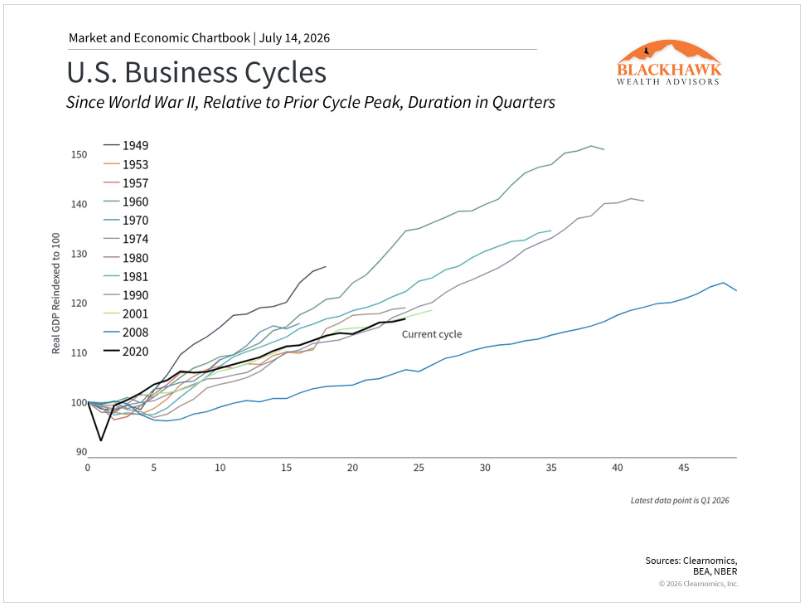
Today, the economic picture remains broadly positive. The job market has strengthened this year, with payroll growth now averaging 111,000 jobs per month, above the long-term average. Consumer spending has also held up, business investment has accelerated due to AI trends, and the dollar has stabilized. So, consumers and corporations – two of the three legs of the “economy stool” – are solid. The third leg is the government. We know they are spending!
One potential challenge is that inflation remains elevated, largely because of higher energy prices. While the peace deal framework and ceasefire with Iran have been tentative, oil prices have still declined back toward their pre-conflict levels. This suggests that inflation may be near its high point for this cycle, although there are no guarantees on how this develops. However, this week’s CPI report may be the beginning of a less troublesome inflation condition.
Steady economic growth has supported the stock market, with the S&P 500 reaching 24 new all-time highs so far this year. The S&P 500 returned 9.6% in the first half, while the Nasdaq gained 12.8% and the Dow Jones Industrial Average rose 8.9%. The second quarter was particularly strong, with the S&P 500 returning 14.9%. This was due to the timing of the market rebound, which began at the end of March. Apparently shrugging off the war, the U.S. stock market rallied in Q2 boosted by super-strong earnings. I think earnings have been the star of the show in 2026.
First quarter earnings season kicked-off in April and gave investors a lot to cheer. The SP 500 reported 28.6% earnings growth in Q1. That was the highest since Q4 2021. With Q2 earnings officially underway now, it is likely to be only the 6th time in history that SP 500 earnings grow by 20% or more in two consecutive quarters. Upcoming Q2 earnings are likely to exceed 21%. It’s been all about the tech sector, driven by AI. Technology is expected to play the dominant role again in 2Q26, with earnings growth +42%. Excluding the Tech sector’s substantial contribution, Q2 earnings growth for the rest of the S&P 500 index is expected to be +11.3%. It is worth noting that U.S. stock valuations are elevated, with the S&P 500 trading at roughly 20 times forward earnings, above the long-term average of 16 times. High valuations do not predict what markets will do in the near term, but they are an important consideration.
For bond holdings, the current yield environment is among the most attractive in recent decades. The Bloomberg U.S. Aggregate Bond Index yields approximately 4.7%, well above its average of 3.0% since 2009. Investment-grade corporate bonds yield 5.1%. Bonds do their job, providing a source of income and a stabilizing force in a balanced portfolio.
Looking Ahead to the Second Half
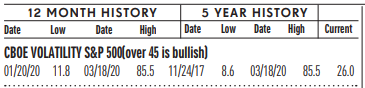
There will no doubt be more periods of market volatility ahead. Yes, you hear and read that everywhere – as you should. And you certainly won’t get a sense of a near term down-turn from the VIX, the investor’s fear index. Remember Warren’s wisdom, “Be fearful when others are greedy, and greedy when others are fearful.”Yesterday Mr. Buffett said something that may be quoted over and over in the years ahead. “It’s tough to find values when everybody is preferring gambling”, was his quote in an interview yesterday on the market now. Market swings from the war in Iran, speculation of the Fed’s next move, and higher-for-longer energy prices will lift inflation fears. Also, the November midterm elections will attract attention in the media. On that note, while it can be difficult to do, it’s important to keep our political views and financial goals separate. Markets have historically been positive under every combination of political party control. While headlines out of Washington D.C. may create short-term swings, the true drivers of markets are corporate earnings, economic fundamentals, and the business cycle. Note the two graphs below. They show volatility due to oil shocks and mid-term elections have historically been short-term.
Artificial intelligence investment demand is expected to further increase stocks supply the rest of this year. Large technology companies are investing heavily in AI infrastructure, and high-profile IPOs including OpenAI and Anthropic are anticipated later this year. In terms of dollars raised, the first half of 2026 rewrote the IPO record books, with U.S. share sales raising a staggering $251 billion by late June. The blockbuster SpaceX IPO — one of the largest share sales in history — alongside AI chipmaker Cerebras, accounted for a massive portion of the total capital raised. 2026 will potentially be the biggest IPO year ever by sheer capital raised. Overall, this reflects market optimism. The key lesson from prior technology cycles is to take a longer-term view. During periods of rapid innovation, it can be difficult to identify the long-term winners in advance. The largest technology stocks today have taken decades to grow into the companies they are today.
|