ERPE Excerpts 5.8.2025 Buffett Baton Passes On

Bi-MONTHLY MARKET ANALYSIS &

ECONOMIC UPDATES

May 8, 2025

Buffett’s Baton Passed On

The image above is an AI generated image of Warren Buffett sitting at his favorite place, enjoying his favorite drink. Sitting at his desk at the company he founded, still at 94, with a Coke in his hand is how I picture Mr. Buffett. Isn’t AI amazing!? While the image is not real, what is real is Warren Buffett surprised the world with the announcement last Saturday that he was retiring as the CEO of Berkshire Hathaway – even his successor, Greg Abel, was surprised. The news was a spoiler alert for me. I had set my TV to record the annual Berkshire Hathaway shareholder meeting that CNBC was broadcasting live from Omaha. It was a 6 hour show. I watched the first 5 hours over the weekend and decided to tune it for the last hour Monday. You can guess what the first thing I learned by turning on the business news early Monday morning. “Berkshire shareholders are ‘stunned’ as Warren Buffett announces plan to step down after 6 decades”, is what I read. I still watched the last hour.

Greg Abel has some very big shoes to fill at year end when Mr. Buffett passes on his baton. Warren Buffett has established himself as one of the most distinguished investors of all time through his exemplary stewardship of Berkshire Hathaway. His investment philosophy is rooted in value investing, a discipline emphasizing purchasing undervalued assets with long-term growth potential. Buffett’s disciplined approach, combined with profound market insights, has yielded extraordinary financial results and set a benchmark in the world of investment. Under Buffett’s guidance, Berkshire Hathaway has become a conglomerate of diverse businesses, exemplifying strategic diversification and disciplined capital allocation. His exceptional investment insights have not only amassed unparalleled wealth but also influenced countless investors and financial standards worldwide. His sense of a solid business coupled with his long-term vision and patience led him to buy companies such as GEICO, See’s Candies, Benjamin Moore paint and Clayton Homes. His diversified portfolio of companies include energy, transportation, finance, textiles and industrial equipment manufacturing. In total, Berkshire Hathaway has 189 “Operating Companies”, which are companies it owns as opposed to investments it holds in public companies such as Coca-Cola and Apple. Just think about the amount of confidence Buffett must have in Mr. Abel. He has praised Abel’s business acumen, his understanding of Berkshire Hathaway’s culture, and his ability to lead and manage a diverse range of businesses. He expressed his ultimate trust in Abel when he said to close Saturday’s shareholder meeting, “I think the time has arrived where Greg should become the chief executive officer of the company at year end.” While this announcement by Warren was a surprise, it was only the timing that was not expected. Greg was known to be Buffett’s heir apparent. In this year’s Letter To the Shareholders, Warren wrote, “At 94, it won’t be long before Greg Abel replaces me as CEO and will be writing the annual letters. Greg shares the Berkshire creed that a “report” is what a Berkshire CEO annually owes to owners. And he also understands that if you start fooling your shareholders, you will soon believe your own baloney and be fooling yourself as well.”

Mr. Buffett was asked a long list of questions over the 6 hour shareholder meeting. Two were what investment plans does he have for the roughly $350 billion Berkshire Hathaway now has in cash (and equivalents), and will the company pay a dividend. It is hard to guess how Buffett plans to invest that mound of cash. One thing we know is he is patient, and is able to “Just sit there and watch pitch after pitch go by and wait for the one right in the sweet spot,” as he has said of himself. Bill Gates once said about Buffett, “Warren likes to say that a good business is like a castle and you’ve got to think every day: Is the management growing the size of the moat? Or is the moat shrinking?” $350 billion can buy a lot of castle! On the topic of dividends, Buffett has long opposed to paying one, but that may change with the new CEO. Under Mr. Abel’s leadership, Berkshire may pay a dividend as early as next year. That’s certainly something Berkshire Hathaway could do with its massive stash of cash.

TAKING PERSPECTIVE…

Proper Perspective:  In our hectic and often hard to comprehend world, it is very easy to lose perspective. You may agree it is sometimes difficult to see the big picture. The media often doesn’t help with this, but unfortunately instead encourages us to see things in a most negative light. Here is hopefully a pause to gain positive perspective.

Famous Quote On This Day:  “Well, let me just first tell you how I feel about unemployment. This is the problem above all which must be solved.”

~~ Ronald Reagan, 1982

What Happened On this Day May 8, 1886 – Pharmacist Dr. John Styth Pemberton invents a carbonated beverage, later named “Coca-Cola”.

MARKET ANALYSIS

INDICATORS OF INTEREST:

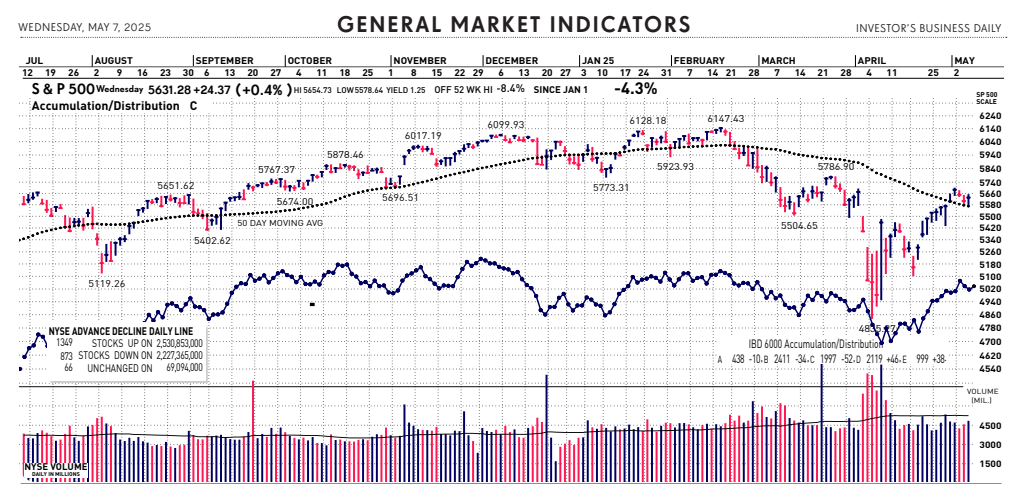
  • Market’s Current Signal: Market in Correction.  Analysis of the stock market over 130 years of history shows we can view it in terms of three stages -market in uptrend, uptrend under pressure and market correction.  Since the 1880’s, this perspective has led to investment out-performance relative to market indexes. This is due to trend analysis which determines risk reducing, return enhancing market entry and exit points. The U.S. stock market’s current signal indicates the market is in correction mode. That officially happened March 13.

The Stock Market Trend: Confirmed Uptrend. The stock market powers higher Tuesday, April 22 and the Nasdaq and S&P 500 confirmed new rally attempts. This follow-through signaled a Confirmed Uptrend.

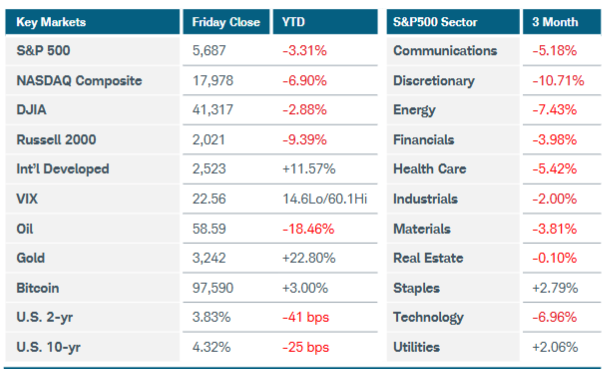
Here are key market levels as of Monday, May 5, 24.

Recapping Last Week

U.S. equity indices rose for a second straight week after a solid jobs report and optimism around tariff negotiations with China. The S&P500, Nasdaq Composite, and Russell 2000 indices all advanced around 3%. S&P500 sector performance was broadly positive. Technology jumped 4% as better-than-expected earnings from Microsoft outweighed some underlying weakness in Apple and Amazon’s reports. The energy sector underperformed, pressured by a 7% plunge in crude oil prices to $58.50 per barrel. Gold futures continued their recent pullback from record highs, while Bitcoin inched closer to $100,000 per coin. U.S. Treasury yields initially fell after the Q1 advance GDP report revealed that economic growth contracted by 0.3%, the first such decline in three years. As expected, surging imports by companies stocking up on inventory ahead of tariffs was the main drag on growth. However, consumers also boosted purchases as spending increased at a 3% annualized rate in the first quarter. Inflation levels remained elevated, with the core PCE index expanding by 3.5%—although that number began to cool at the end of the quarter. U.S. job growth was better than expected in April, flipping Treasury yields to positive for the week. Non- farm payrolls increased by 177,000, and while the prior two months were revised lower, the unemployment rate held steady at 4.2%. U.S. consumer confidence sank to five-year lows on tariff concerns with one-year inflation expectations rising to 6%. Although President Trump signed an executive order easing auto tariffs last week, both General Motors and Ford warned of bottom- line impacts that could still be in the billions of dollars.

Overseas, the Bank of Japan kept interest rates steady at 0.5% while slashing 2025 growth estimates in half. In China, manufacturing activity fell more than expected last month as demand softened, while services PMI slipped but remained in expansion territory. Economic growth in the Eurozone was better than forecasted in Q1 at 0.4%, but the region’s largest contributor, Germany, expanded by just 0.2%. Eurozone inflation was stubbornly unchanged in April at 2.2%, complicating projections for the interest rate outlook. Finally, Canadian Prime Minister Carney is scheduled to visit the White House soon after his Liberal Party scored a stunning turnaround to win last week’s federal election

Current View

The stock market’s Confirmed Uptrend is still indicating bullish behavior. Today the market got a boost from a trade agreement between the U.S. and the U.K. The Prime Minister of the U.K. and President Trump consummated an “historical” trade deal. Yesterday the market also was lifted by positive tariff news in the final minutes of trading. The news was particularly good for the chip sector. In addition, yesterday was a “Fed Day”. The stock market took the latest Federal Reserve meeting in stride and ended yesterday higher on reports the Trump administration plans to relax chip export restrictions. As ever, all eyes were on the Federal Open Market Committee’s latest decision on interest rates. As expected, central bankers held rates steady and remained in wait-and-see mode. The short-term interest-rate target has sat between 4.25% and 4.5% since December. The committee, in its post-meeting statement, warned that “the risks of higher unemployment and higher inflation have risen.” Federal Reserve Chairman Jerome Powell struck a cautious tone during his news conference. He said trade negotiations have “the potential to change the picture materially” and that the committee is currently “in a good position to wait and see” before taking action on rate cuts. On balance, the FOMC seems to believe there is less risk in waiting for clear data than from moving preemptively, which could lead to a policy mistake. A report that the Trump administration is planning to relax export restrictions on artificial intelligence chips gave stocks a late boost. It came after Bloomberg reported the Trump administration will move to rescind a Biden-era rule, issued in the dying days of that administration, that aimed to curb AI chip exports to China.

  • Industry Group Strength:  BEARISH. As of yesterday, 56 out the 197 groups I monitor are up year-to-date. 141 groups are down for the year.
  • New Highs vs. New Lows:  BULLISH. In yesterday’s session, there were 109 new 52-week highs and 27 new 52-week lows.
  • Dow Dividend Yield:  BEARISH. The current yield for the Dow Jones Industrial Average is 1.96%. The 10-year Treasury now 4.35%.
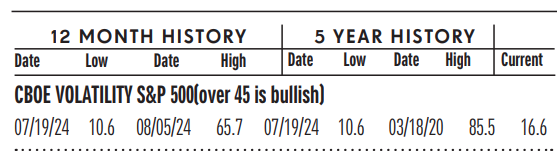
  • Volatility Index: NEUTRAL. Volatility has been volatile. The “VIX” is now 22, down from 28 as two weeks ago. The index is also known as the “Fear Index.” It is considered a contrarian indicator and therefore viewed as bullish as it rises indicating investors are becoming more fearful. The VIX:
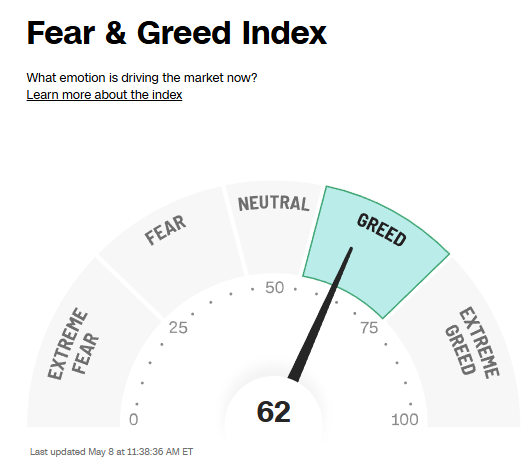
  • Fear / Greed Index: BULLISH.  Investors are driven by two emotions: fear and greed. Too much fear can create a condition of oversold/ undervalued stock prices. Too much greed can result in overbought/overvalued stock prices. The AAII Investor Sentiment Index is now neutral.   BE FEARFUL WHEN OTHERS ARE GREEDY. At 62, the Fear & Greed Index is up from 30 two weeks ago. Remember, the index was at 3 a month ago!

CLICK VIDEO FOR MORE ON THE “FEAR & GREED INDEX”

How CNNMoney’s Fear & Greed Index works

  • Bull / Bear Barometer:  BULLISH. This secondary market indicator should also be viewed with a contrarian perspective. As of yesterday, according to the latest survey of stock market newsletter writers by Investor’s Intelligence, the bullish tally is 32.1% up from 23.5% 2 weeks ago. The bears are 33.9%, up from 35.6% 2 weeks ago. Consider this a contrarian indicator because the crowd is often wrong at market tops and bottoms. In other words, extreme bullishness has been seen near several market tops in the past, while extreme bearishness has been seen at market bottoms.
  • Put / Call Ratio: BULLISH. The ratio of put-to-call options is 0.96, down from 1.46 2 weeks ago. The put-call ratio tracks the mood of what options investors are doing, not just saying. They typically buy puts if they think a stock will decline and calls if they think it will rise. If they’re buying lots of puts, they see the market declining. And if they’re loading up on calls, they’re generally bullish. Historically, market bottoms occurred when the reading spikes to 1.2 or more. Market tops are often made when the reading is 0.6 or less. Note how reliable this is with respect to the February record low coinciding with the market high. Keep in mind this is also a contrarian indicator.

ECONOMIC UPDATES

Global Economic Indicators & Analysis:

POSITIVE INDICATORS

Jobless Claims Down:  Initial jobless claims fell by 13,000 to 228,000 in the last week, the Labor Department said today. That’s a return to recent trends. Despite uncertainty over trade policy, companies are not moving to cut jobs through layoffs. Economists polled by the Wall Street Journal had estimated new claims would fall by 11,000 to 230,000. The number of new claims based on actual filings — that is, before seasonal adjustments — fell by 16,972 to 206,937 in the latest week. The number of people already collecting unemployment benefits in the week of April 26 fell by 29,000 to 1.88 million, the government said. The bigger picture is that companies are holding on to workers, despite uncertainty over trade policy and the contraction in first-quarter gross domestic product. The Federal Reserve on Wednesday described the labor market as “solid.”

Consumer Spending Up: Personal spending rose 0.7% last month, the government said last Wednesday, a few ticks above the forecast of economists polled by The Wall Street Journal. Consumer spending rose briskly in March, but not because Americans are gung-ho on the economy. But because they were trying to beat the boost in prices due to tariffs. Many bought new cars or other items to avoid potential price increases tied to U.S. trade wars. New-car sales were the biggest driver, as Americans bought the most cars in four years. Auto-related spending surged 57% in March, an unusually large increase. Sales of home furnishings, appliances and other big-ticket items also rose. These are items mostly produced overseas and subject to tariffs. Consumer spending is the main engine of the economy, accounting for 70% of all activity. The big question is whether households can — or will — keep it up. Consumer confidence has plunged because of President Donald Trump’s trade wars. As a result, businesses have become more reluctant to hire and invest.

U.S. Service Sector Up: In April, US service sector business activity growth was the slowest in nearly a year-and-a-half, according to the latest Institute for Supply Management on Monday. The Institute for Supply Management said on Monday that its service-sector PMI rose to 51.6% in April from 50.8% in the prior month. Economists polled by the Wall Street Journal had expected the ISM index to slip to 50.4%

WEAK INDICATORS

Productivity Down: Worker productivity, one of the biggest drivers of a strong U.S. economy since the pandemic, stumbled in the first quarter of 2025, for the first time since the second quarter of 2022. U.S. productivity decreased at a 0.8% annual rate in the first quarter, the government said today. Economists surveyed by the Wall Street Journal had projected a 0.7% decrease. Over the past four quarters, U.S. productivity has increased at a 1.4% pace, the slowest pace since the first quarter of 2023.

LEI Down:  The consumer-confidence index sank in April to the lowest level since the depths of the COVID-19 pandemic, the Conference Board said last Tuesday. Confidence fell 7.9 points to 86.0 in April, the fifth straight monthly decline. Economists polled by the Wall Street Journal had forecast the index to register 87.3 in April from the initial March reading of 92.9. The so-called expectations index, which measures how people think the economy will look six months from now, tumbled 12.5 points from 54.4. That’s the weakest reading since October 2011. It is well below the threshold of 80 that usually signals a recession ahead.

GDP Down: The U.S. economy contracted in the first quarter of 2025 for the first time in three years, reflecting a surge in imports ahead of President Donald Trump’s tariffs and a slowdown in consumer spending. Gross domestic product, the official report card on the economy, shrank at a 0.3% annual rate from January to March, the government said last Wednesday. It’s the first contraction in GDP since early 2022. The biggest trade wars since the Great Depression have stunted the economy and raised the risk of recession. Economists warn that growth could slow even further and inflation could rise if the disputes aren’t settled soon. The biggest culprit behind the negative reading in the first quarter was a record surge in imports as U.S. businesses sought to bring in foreign goods before the tariffs, which typically raise the cost of imports, took effect. The record trade deficit shaved a whopping 4.8 percentage points off GDP.

Trade Deficit Down: The U.S. international trade deficit, including goods and services, widened 14% in March to a record seasonally adjusted $140.5 billion, the Commerce Department said Tuesday, as companies rushed to import foreign products while they were slightly cheaper than they would be with White House tariffs added to the cost. Economists surveyed by The Wall Street Journal had predicted the deficit would widen to $136 billion from $122.7 billion in February. Year-to-date, the trade deficit has doubled from last year. Exports increased 23.3%.

Big picture: The trade deficit has been a record drag on growth in the first quarter as companies raced to avoid tariffs on imports. A trade deficit subtracts from gross domestic product since it means the U.S. is buying relatively more goods and services from foreign suppliers instead of American producers. The key question is how long this effect of the Trump tariff policy will persist.

Jobs Market Down: The number of job openings in the U.S. fell in March to a six-month low just as some of the Trump administration’s tariffs began to kick in, but the big question is what will happen in the coming months as the trade wars drag on. The answer is still unclear, but surveys show many businesses plan to freeze hiring until they get a better sense of how the economy is responding. New job postings dropped to 7.2 million in March from 7.5 million in the prior month, the government said last Tuesday. That’s the fewest openings since September and reflects low levels last seen at the tail end of the pandemic.

Call me if you have any questions. I am always happy to help!

John J. Gardner, CFP®, CPM®.

Blackhawk Wealth Advisors, Inc.

3860 Blackhawk Rd. Ste. 160 Danville, CA. 94506

Phone: 888-985-PLAN · Email: jg@blackhawkwealthadvisors.com

BLACKHAWKWEALTHADVISORS.COM

For my Market Monthly podcast, click on the link below. I provide a review of global stock market highlights over past month and preview of the month ahead. Forward insights and perspectives are based on current financial market and economic trends with an emphasis on relevant developments in various areas from Fed policy to company earnings announcements.

810c9060-6bc9-4e20-948f-60bee7c1b0be image
dc6d6594-dfce-48b0-8d69-3a27db12748d image
7d2eabf6-51c8-425f-b667-128ed7bc0dd2 image

Blackhawk Wealth Advisors is the parent corporation of Equity Research & Portfolio Evaluation and Blackhawk Asset Management. It’s Chief Investment Officer is John J. Gardner. John is a Certified Financial Planner (CFP®) and Certified Portfolio Manager (CPM®). As an AIF®, John is also an Accredited Investment Fiduciary.

CUSTOMIZED. STRATEGIC. DYNAMIC.