|
This year the first born Baby Boomers turn 80. 2026 marks a massive demographic shift as the vanguard of the 76 million Baby Boomers officially becomes octogenarians (80 – 89 years old). Here’s to celebrating the milestone! Since they were born in 1946, those first “Boomers” have already outlived the current average U.S. life expectancy is 78.9 years, so these folks are beating the average.
Anyone born between the years of 1946 and 1964 is considered a Baby Boomer, and for a time, this generation peaked at making up 37% of the US population, with 72.5 million Boomers. Today, Boomers make up 20% of the population, with 67 million members. According to Agebuzz.com, there are 14.7 million Americans aged 80 and over in the US, and that number is expected to double by 2045. As has happened throughout the history of Baby Boomers, they have had an immense impact on the U.S. economy and have shaped product and service provider’s business decisions. Prior “rules” have been broken (in this case, rules about longevity and life expectancy). While Boomers are a better educated, healthier, and more diverse older population than we’ve ever experienced as a country, they will also face challenges related to retirement planning and financing, chronic illness, and caregiving. With this newfound longevity, some may be able to afford a comfortable retirement, but many will be daunted by healthcare costs and rising poverty rates (older Americans are the only group to have experienced upswings in poverty in recent years). The latest data show that 15% of older adults lived in poverty in 2024, compared to 10.7% in 2021. Many Baby Boomers are working longer than previous generations, but many will also face a steep climb trying to pay for the long term care they will likely need. A recent Op-Ed in Marketwatch estimated that those reaching 85 (likely a significant number of current Baby Boomers) will require nursing home care at 8x the rate of younger adults aged 65-74. This could be good news for future healthcare professionals. It’s estimated that each year over the next decade, we will need 700,000 more home-health aides. Here are some additional challenges, constraints and planning techniques for the octogenarian (and younger) Boomers:
Investment & Estate Concerns: From Accumulation to Distribution
- Estate Tax Thresholds: A critical 2026 fact is the One Big Beautiful Bill Act, which set the federal estate tax exemption at $15 million per individual. This allows for significant legacy planning, but it also means estates approaching that ceiling need proactive gifting strategies.
- Tax-Alpha Management: With the current federal estate tax exemption at $15 million, the focus should be on “Step-Up in Basis” optimization. Holding highly appreciated individual stocks until they pass to heirs can effectively eliminate decades of capital gains taxes. For those 80+, the “step-up in basis” at death remains a primary tool for wiping out decades of capital gains, often making “holding until death” a more viable tax strategy than selling. I often recommend the “Hedge & Monetize” portfolio management technique to effectively handle low cost/high concentration stock holdings.
- The RMD Pressure: Octogenarians face steeper Required Minimum Distributions (RMDs). A key strategy for your readers might be Qualified Charitable Distributions (QCDs)—the 2026 limit is $111,000, allowing them to satisfy RMDs while keeping that income off their tax returns.
Investment Perspective: The “Phase 3” Portfolio Strategy
As the leaders of the Baby Boomers enters their 80’s, the investment mandate has likely shifted twice: from “Wealth Accumulation” to “Growth with Protection” and now on to phase 3 – “Utility and Legacy.” For this cohort, the portfolio is no longer just a retirement fund; it is a tool for maintaining autonomy and streamlining the eventual transfer of wealth.
Key Focus Areas:
- The Liquidity Ladder: Maintaining a three-to-five-year “liquidity bucket” of cash equivalents and short-term high-quality bonds. This prevents the need to sell equities during a market downturn to cover RMDs or sudden health expenses.
- Simplification: This is the decade to consolidate “stray” accounts. Moving assets into a single custodial environment reduces the administrative burden on both the client and their eventual executors or power of attorney.
- The Success Tax: Large IRAs are often “ticking tax bombs” for heirs. For those who do not need their full RMD for lifestyle expenses, 2026 is an ideal year to maximize the $111,000 Qualified Charitable Distribution (QCD) limit to lower their taxable estate.
- The “Longevity Risk”: A healthy 80-year-old today has a high probability of living to 90 or 95. Planning for a 15-year horizon is still a long-term investment strategy. That’s a “risk” we all may wish to have… but still requires a plan.
For those of you with good memories and recollections of how life has evolved during the Baby Boom generation, go ahead and try your hand at a quiz on Pop Culture from PBS… see how many you get right (it comes with the answers). HERE’S THE LINK TO THE QUIZ.If it’s your 80th birthday this year, Happy Birthday and welcome to the Octogenarian club!
|
|
|
Proper Perspective: In our hectic and often hard to comprehend world, it is very easy to lose perspective. You may agree it is sometimes difficult to see the big picture. The media often doesn’t help with this, but unfortunately instead encourages us to see things in a most negative light. Here is hopefully a pause to gain positive perspective.
|
|
|
Famous Quote For Today: “Nobody has tried to swallow us since I’ve been here. I think they are afraid how we would taste.”
~~Steve Jobs, 1998
Today in History – On this day in 1864, US mints 2 cent coin with the 1st appearance of “In God We Trust”.
|
|
|
INDICATORS OF INTEREST:
- Market’s Current Signal: Confirmed Uptrend. Analysis of the stock market over 130 years of history shows we can view it in terms of three stages -market in uptrend, uptrend under pressure and market correction. Since the 1880’s, this perspective has led to investment out-performance relative to market indexes. This is due to trend analysis which determines risk reducing, return enhancing market entry and exit points.
The U.S. stock market’s current signal indicates the market is in Confirmed Uptrend. This trend change was triggered yesterday, confirming a rally attempt on March 31.
|
|
|
Here are key market levels as of Monday, April 20:
|
|
Recapping Last Week
U.S. equity indices rallied sharply for a third straight week as Middle East tensions rapidly deescalated. Iran’s statement that the Strait of Hormuz was open for commercial shipping during the ceasefire window throttled risk on across all asset classes on Friday. Oil prices fell over $10 per barrel on Friday alone, helping to ease inflation fears across the globe. The S&P500 and Nasdaq-100 advanced 4.5% and 6% respectively, meaning the former has risen 13% the latter 17% since their March 31st lows. Small cap stocks were even stronger, with the Russell 2000 and Nasdaq Composite soaring 6% and 7%. Within the S&P500 itself, the winning themes were growth and travel. The Iranian situation is far from resolved, so while the progress toward peace is welcome, macro investors can likely expect volatility to persist a bit longer. Rate-sensitive sectors showed continued vulnerability: housing, for example, remained a weak spot, with existing home sales falling to 3.98 million and the NAHB coming in at 34, indicating builder sentiment remains under pressure. Small business optimism declined to 95.8, but both here and with housing, these readings are somewhat moderated by indications of more favorable conditions on the horizon. On the inflation front, PPI was impacted significantly by the situation in Iran, rising 0.5% m/m (4.0% y/y), though hopefully that situation will prove temporary. Growth indicators remain mixed but stable with the Empire manufacturing index coming in weak vs. a stronger Philly report. Industrial production dipped, but labor markets remained firm as jobless claims were below expectations at 207K. Overall, the US economy looks stable and benefited from a big boost on Friday. The energy shock had been a huge weight on every economy on Earth—the latest developments increased the likelihood that global growth for the year would meet the IMF’s base case of 3%, rather than the 2% that could have prevailed had the Strait remained closed.
Overseas, European industrial production remained positive, though the ECB still notes downside growth risks and upside inflation risks. The drop in energy prices also provides some cushion. UK GDP came in at 0.5% and Australia’s unemployment rate held steady at 4.3%, indicating the labor market remains tight. China’s data reinforces the stabilization narrative with GDP printing at 5% and industrial production at 5.7%. Their exports were weak at 2.5% but import growth of 27.8% signaled internal resilience. The global economy is hoping inflation expectations and lower geopolitical tensions will be tempered by additional drops in energy prices. If that can hold, conditions should be favorable for the near future.
Current View
Yesterday showed a convincing continuation of the confirmed rally that started April 8. Both the Nasdaq composite and the large-cap S&P 500 logged new highs. Yesterday was the 4th all-time new high for the SP 500 since the start of the war in Iran. Recent stock market strength indicates robust demand from the institutional crowd, including hedge funds, pension plans, college endowment funds, large investment advisers, and mutual funds. However, the angst over what direction in which the U.S.-Iran war will take still hangs over the stock market. The potential impact of high energy prices on consumer spending, a huge portion of the nation’s economy, cannot be ignored. WTI crude oil futures gained more than 3% and at one point hit $93.73 a barrel. Oil (WTI) is already up another 1.3% this morning. Earnings, as usual, are a dominant driver of individual stock direction. Today is a stark reminder of that. Leading minerals company, FCX, slid 13% on its earnings report. ServiceNow, a large component of the enterprise software group, cratered 17% this morning in investors reaction to its quarterly earnings announcement. Tesla is also getting hit by its earnings report today. On the upside, my top choice for this year’s MoneyShow Show Top Picks, GEV, is up strongly on solid earnings and revenue gains announced today (it is now up over 75% ytd).
|
|
- Industry Group Strength: BULLISH. As of yesterday, 130 out the 197 groups I monitor are up year-to-date. 67 are down.
- New Highs vs. New Lows: BULLISH. In yesterday’s session, there were 340 new 52-week highs and 47 new 52-week lows.
- Dow Dividend Yield: BEARISH. The current yield for the Dow Jones Industrial Average is 1.8%. The 10-year Treasury now 4.30%.
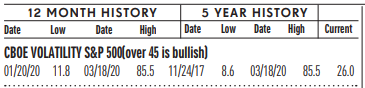
- Volatility Index: NEUTRAL. Volatility has been volatile. The “VIX” is now 19. This is down from 20 two weeks ago. The index is also known as the “Fear Index.” It is considered a contrarian indicator and therefore viewed as bullish as it rises indicating investors are becoming more fearful. The VIX:
|
|
- Fear / Greed Index: BULLISH. Investors are driven by two emotions: fear and greed. Too much fear can create a condition of oversold/ undervalued stock prices. Too much greed can result in overbought/overvalued stock prices. The AAII Investor Sentiment Index is now neutral. BE FEARFUL WHEN OTHERS ARE GREEDY. At 68, the Fear & Greed Index is up down 36 two weeks ago.
|
|
|
CLICK VIDEO FOR MORE ON THE “FEAR & GREED INDEX”
|
|
- Bull / Bear Barometer: BULLISH. This secondary market indicator should also be viewed with a contrarian perspective. As of yesterday, according to the latest survey of stock market newsletter writers by Investor’s Intelligence, the bullish tally is 48.1%, up from 39.6% two weeks ago. The bears are 21.1%, down from 27.7% two weeks ago. Consider this a contrarian indicator because the crowd is often wrong at market tops and bottoms. In other words, extreme bullishness has been seen near several market tops in the past, while extreme bearishness has been seen at market bottoms.
|
- Put / Call Ratio: NEUTRAL. The ratio of put-to-call options is .82, down from 0.90 two weeks ago. The put-call ratio tracks the mood of what options investors are doing, not just saying. They typically buy puts if they think a stock will decline and calls if they think it will rise. If they’re buying lots of puts, they see the market declining. And if they’re loading up on calls, they’re generally bullish. Historically, market bottoms occurred when the reading spikes to 1.2 or more. Market tops are often made when the reading is 0.6 or less. Note how reliable this is with respect to the February record low coinciding with the market high. Keep in mind this is also a contrarian indicator.
|
|
|
Global Economic Indicators & Analysis:
POSITIVE INDICATORS
|
|
Retail Sales Up: Retail sales jump to a 3-year high due to surging gas prices, but consumers also aren’t showing any quit. Retail receipts jumped 1.7% last month, the government said Tuesday, after factoring in seasonal patterns in sales. That’s the largest increase since the beginning of 2023. Gas stations saw a 15.5% surge in sales after the Iran war fueled a big increase in prices at the pump. The increase in retail spending in March wasn’t entirely due to higher gas prices or inflation. Virtually every retailer reported higher sales for the second month in a row. Robust retail sales in the first three months of the year could pave the way for a rebound in gross domestic product in the first quarter. GDP is the official scorecard of the economy.
|
|
Manufacturing Business Outlook Survey Up: Manufacturing activity continued to grow overall, according to the firms responding to the April Manufacturing Business Outlook Survey. The survey’s indicators for general activity, new orders, and shipments all moved higher this month. However, the employment index fell and turned negative, suggesting overall declines in employment. Both price indexes rose for the second consecutive month. The firms continue to expect overall growth over the next six months, although most future indicators moved down.
|
|
Empire State Manufacturing Survey Up: Business activity increased moderately in New York State in April, according to firms responding to the Empire State Manufacturing Survey. The headline general business conditions index rose eleven points to 11.0. New orders and shipments increased significantly. Unfilled orders rose and delivery times lengthened. Supply availability worsened somewhat. Employment expanded and the average workweek increased. The pace of input price increases picked up sharply after slowing last month, while the pace of selling price increases was little changed. Firms remained optimistic that conditions would improve in the months ahead, though optimism moderated and capital spending plans weakened.
|
|
|
Jobless Claims Up: The number of Americans filing claims for unemployment benefits increased slightly last week, pointing to continued labor market stability in April, though economic uncertainty and higher prices stemming from the war with Iran pose downside risks. Initial claims for state unemployment benefits rose 6,000 to a seasonally adjusted 214,000 for the week ended April 18, the Labor Department said today. Economists polled by Reuters had forecast 210,000 claims for the latest week.
|
|
PPI Up: U.S. inflation at the wholesale level rose to a three-year high in March due to surging oil prices tied to the Iran war, but aside from energy, the increases in the cost of other goods and services were surprisingly tame. The producer-price index jumped 0.5% last month, the government said Tuesday, to mark the fourth straight big increase. Economists polled by the Wall Street Journal had forecast a sharper 1.1% advance. The rise in wholesale prices in the last 12 months climbed to 4%, up from 3.4% in the prior month. That’s the highest level in three years. Price increases at the wholesale level raise the costs consumers pay for goods and services to varying degrees. Even if the Iran conflict ends soon, the rate of U.S. inflation is bound to continue to rise in the next few months, remaining well above the Federal Reserve’s 2% target. The Fed won’t have much leeway — if any — to cut interest rates and reduce borrowing costs on mortgages and other loans if inflation is heading higher.
|
|
Housing Market Index Down: Builder confidence in the market for newly built single-family homes fell four points to 34 in April. Here are the readings for the three HMI indices in April: Current sales conditions fell four points to 37. Sales expectations in the next six months dropped seven points to 42. Traffic of prospective buyers posted a three-point decline to 22. Signs of Market Cooling – The latest HMI survey also revealed that 36% of builders cut prices in April, down slightly from 37% in March. The average price reduction was 5%, down from the 6% figure in March. The use of sales incentives was 60% in April, down from 64% in March, and marking the 13th consecutive month this share has reached 60% or higher.
|
|
Existing Home Sales Down: Existing-home sales decreased by 3.6% in March 2026. Month-over-month sales fell in all regions. Year-over-year sales rose in the South and West and declined in the Northeast and Midwest. According to NAR Chief Economist Dr. Lawrence Yun. “March home sales remained sluggish and below last year’s pace. Lower consumer confidence and softer job growth continue to hold back buyers. Because inventory remains limited, the median home price rose to a new record high for the month of March,” Yun added. “That price growth has helped the typical homeowner accumulate $128,100 in housing wealth over the past six years.”
|
|
Industrial Production Down: Industrial production dropped 0.5% in March but still grew at an annual rate of 2.4% in the first quarter. Similarly, manufacturing output ticked down 0.1% in March yet grew at a 3.0 percent rate in the first quarter. The indexes for mining and for utilities moved down 1.2 and 2.3 percent, respectively, in March. At 101.8 percent of its 2017 average, total industrial production was 0.7% above its year-earlier level. Capacity utilization receded to 75.7%, a rate that is 3.7 percentage points below its long-run (1972–2025) average.
|
|
|
Call me if you have any questions. I am always happy to help!
John J. Gardner, CFP®, CPM®.
|
|
|
Blackhawk Wealth Advisors, Inc.
|
|
|