ERPE Excerpts 10.9.2025 ….. CORRECTION…The Last 25 Years

Bi-MONTHLY MARKET ANALYSIS &

ECONOMIC UPDATES

October 9, 2025

The Last 25 Years

A Quarter Century in the Stock Market:

Test Your Knowledge With a Quiz…

HERE IS A CORRECTED VERSION OF TODAY’S ERPE EXCERPTS.

In this morning’s distribution, the Excerpts did not include the questions to the quiz. Apologies for that oversight and hope you enjoy taking this brief, fun quiz. Here are the 10 question. Click on the link below for the answers.

1. The Nasdaq Composite Index—and the dot-com bubble peaked at 5048.62 on March 10, 2000. How long did it take for the index to reclaim its closing high?

A. six months

B. two years

C. five years

D. 10 years

E. 15 years

2. How far did the S&P 500 fall from its peak in October 2007 through its financial-crisis bottom in March 2009?

A. 75.4%

B. 63.2%

C. 56.8%

D. 42.1%

E. 22.3%

3. How much did the Dow Jones Industrial Average tumble during the “flash crash” in 2010?

A. 998.5 points

B. 1,052.22 points

C. 347.80 points

D. 754.82 points

E. 1,208 points

4. The 2000s have seen the longest bull market in U.S. history, from 2009 to 2020. How much did the S&P 500 gain during that period?

A. 101%

B. 201%

C. 301%

D. 401%

E. 501%

5. How many times have Dow components been changed during the 2000s?

A. six

B. nine

C. 15

D. 21

E. 30

6. What company had the largest market capitalization at the end of 2000, and what company holds the title today?

A. General Electric and Nvidia

B. Microsoft and Microsoft

C. Walmart and Apple

D. Exxon Mobil and Alphabet

E. Intel and Amazon.com

7. How much did the S&P 500 fall from peak to trough during the Covid 19 decline in 2020?

A. 11.9%

B. 22.9%

C. 33.9%

D. 44.9%

E. 55.9%

8. Over the past 25 years, how often did the S&P 500 have a down year?

A. two times

B. four times

C. six times

D. eight times

E. 10 times

9. The number of publicly traded stocks has fallen over the past 25 years. Do you know how many fewer stocks there are today compared with 2000?

A. 1,000

B. 1,200

C. 1,500

D. 1,700

E. 2,000

10. What have been the best performing and worst-performing stocks currently in the S&P 500 since the turn of the century?

A. Monster Beverage and

Akamai Technologies

B. Deckers Outdoor and

Citigroup

C. Nvidia and American

International Group

D. Texas Pacific Land and AES

E. Old Dominion Freight Line

and Ford Motor.

Some of the answers may surprise you…

There has been a big daily dose of stock market bubble talk lately. Many parallels are being noted comparing the current AI technology bull market run with the “dot-com” internet bubble of the ’90’s that ended badly in March of 2000. I recall those days with great clarity. It seems like yesterday… amazing to think that was 25 years ago. In addition to the implosion of one of history’s greatest stock market bubbles, there have been many other key investment milestones and events over the last 25 years. The 2008 global financial crisis, the COVID-19 pandemic of 2020, and the rise of technology over the last quarter century that has reshaped trading and investor behavior. This period of booms, busts, and technological evolution has significantly altered the financial landscape. Here is a short list of other memorable events since 2000 that meaningfully impacted America and American investors:

  • The 9/11 attacks (2001): Terrorist attacks on the World Trade Center and Pentagon halted U.S. markets for four trading days.
  • Enron scandal (2001): The energy giant filed for bankruptcy after revelations of massive accounting fraud.
  • Lehman Brothers collapse (2008): The collapse of the investment bank Lehman Brothers in September 2008 froze credit markets, deepened the financial crisis, and prompted unprecedented government interventions and bailouts of other major financial institutions.
  • Birth of Bitcoin (2008): In the midst of the financial crisis, an anonymous individual or group known as Satoshi Nakamoto published a paper detailing a new electronic cash system called Bitcoin. It introduced the concept of a decentralized digital currency and the blockchain technology that would later spark the cryptocurrency boom.
  • Facebook IPO (2012): The social media giant’s initial public offering was a highly anticipated event
  • Longest bull market in history (2009–2020): Following the 2008 crisis, a sustained period of rising stock prices became the longest bull market on record. It ended abruptly with the onset of the COVID-19 pandemic.
  • Brexit (2016): The United Kingdom’s surprise vote to leave the European Union caused immediate volatility in global financial markets
  • Meme stock frenzy (2021): Lockdowns, stimulus, and free trading apps fueled an online trading boom, with retail investors coordinating on social media platforms to drive up the price of heavily shorted stocks like GameStop.
  • Inflation and aggressive rate hikes (2021–2022): Massive stimulus and pandemic-related supply chain disruptions contributed to the highest inflation rates in decades. Aggressive interest rate hikes, ending the era of near-zero rates.
  • AI boom (2023–present): The emergence of generative AI and its explosive growth has driven a new wave of investor excitement, with companies like Nvidia at the forefront of the stock market rally.

I recently read a Wall Street Journal article published in its special Journal Report/ Investing Monthly. It highlighted the last Quarter Century in U.S. Stock Markets and included a fun quiz. I thought I would pass it on to you, so, here it is…

Bulls, bears, booms, busts, collapses, and frenzies…. Test your knowledge of some of the major market moments over the past 25 years. Take the quick quiz below of 10 questions and get your score. CLICK HERE FOR THE ANSWERS.

TAKING PERSPECTIVE…

Proper Perspective:  In our hectic and often hard to comprehend world, it is very easy to lose perspective. You may agree it is sometimes difficult to see the big picture. The media often doesn’t help with this, but unfortunately instead encourages us to see things in a negative way. Here is hopefully a pause to gain positive perspective.

Famous Quote On This Day:   “The Genius of Poetry must work out its own salvation in a man: It cannot be matured by law and precept, but by sensation and watchfulness in itself.”

~~ John Keats, 1818

What Happened On this Day October 9, 1888: – The Washington Monument officially opens to the general public.

MARKET ANALYSIS

INDICATORS OF INTEREST:

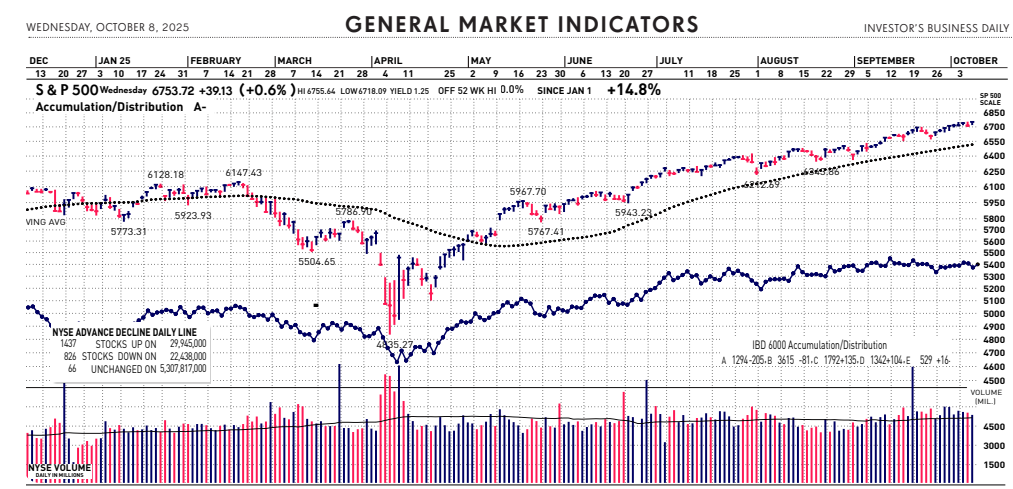
  • Market’s Current Signal: Confirmed Uptrend.  Analysis of the stock market over 130 years of history shows we can view it in terms of three stages -market in uptrend, uptrend under pressure and market correction.  Since the 1880’s, this perspective has led to investment out-performance relative to market indexes. This is due to trend analysis which determines risk reducing, return enhancing market entry and exit points. The U.S. stock market’s current signal indicates the market is in Confirmed Uptrend. That officially happened April 22 and is still intact. This has been the fastest market rebound from a bear market low in history. The uptrend is remains. October 12 is the 3rd anniversary of this bull market.

The Stock Market Trend: Confirmed Uptrend. The stock market powered higher Tuesday, April 22 and the Nasdaq and S&P 500 confirmed new rally attempts. That follow-through signaled a Confirmed Uptrend. In late June the major stock market indexes reclaimed levels set in late February and significantly above the pre-“Liberation Day” level. The major indexes are making new all-time record highs. Yesterday was the 33rd new high of 2025 for the SP 500.

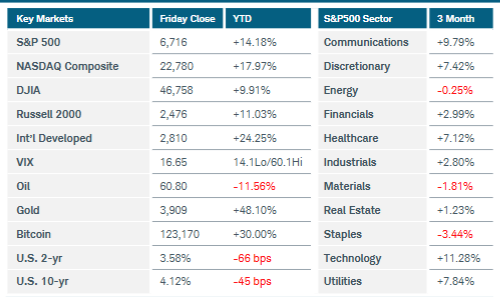
Here are key market levels as of Monday, October 9:

Recapping Last Week

U.S. equity indices recorded yet another weekly record close despite the government shutdown—the 15th such stoppage since 1981 and the first since late-2018. The release of the key September jobs report was a casualty of the shutdown, but weakness in other labor market data lifted odds for two additional rate cuts by year-end. The S&P500, Nasdaq Composite, and Russell 2000 indices rose between 1% and 2%. Strong sector performance was dominated by healthcare, which surged nearly 7% after Pfizer reached a deal with the government to lower prescription drug prices in exchange for relief from tariffs that could otherwise have approached 100%. The agreement sparked optimism that other pharmaceutical companies may be able to negotiate favorable outcomes. Sliding oil prices weighed on the energy sector as crude futures tumbled 7% following news that OPEC+ was weighing another production increase at its October 5 meeting. Gold soared 3% to another all-time high above $3,900 while Bitcoin and Ethereum each spiked 12%. U.S. Treasury yields fell after Wednesday’s ADP private payrolls report revealed a reduction of 32,000 jobs last month. The release garnered more attention than usual given the halt in government data reporting and gave investors more confidence that further rate cuts are forthcoming. According to the JOLTS report, job openings increased only marginally in August while hiring declined. This year has seen employers announce more job cuts than in any year since 2020, while hiring plans are the lowest since 2009. A new “real-time” estimate from the Chicago Fed stated that the unemployment rate was likely unchanged at 4.3%. In other economic news, U.S. consumer confidence worsened this month as concerns over job availability mounted. The ISM manufacturing PMI edged up to 49.1 in September, although new orders and employment remained subdued and prices paid were still elevated. ISM services PMI fell to 50.0 from 52.0 the prior month.

On the international side, inflation in Germany and the wider Eurozone accelerated last month to +2.4% and +2.2%, respectively. Economic trends suggested this was a temporary uptick and the European Central Bank is predicted to keep rates steady later this month. Australia’s central bank held its benchmark rate at 3.6%, acknowledging that economic and inflation data has firmed. In China, September’s manufacturing PMI was the strongest in six months, driven by gains in output and new orders. Last of all, sentiment among Japan’s large manufacturers improved for a second straight quarter, strengthening the case for the Bank of Japan to raise rates. A hawkish shift emerged at last month’s BOJ meeting, with markets pricing in around a 60% chance of a hike at the October 30 gathering.

Current View

What shutdown? Not the stock market. The SP 500 is up 1% over the six sessions since the government shutdown.  With yesterday’s trading at 23,043, the Nasdaq etched a record close for the third time in five sessions. Winners on the Nasdaq led losers by a roughly 2-1 ratio. After powering 7.8% higher in the third quarter, large-cap stocks are off to a strong start in the fourth quarter, ahead of earnings season and a focus on the consumer during the holiday shopping season.  With the government shutdown in day 9, economic data releases have mostly halted. Investor focus will be on company earnings reports. Those start in a heavy way this month. Today Delta Air Lines jumped nearly 7% after reporting results, while Ferrari (RACE) plunged more than 14% in a release today of its long-term outlook ahead of an earnings report.

October 12 is the 3rd anniversary of the bull market. While bubble talk is bubbling up, here’s some bull market perspective. Of all bull markets in over the last 50 years that have reached 3 years, on average average the total duration of the bull run was 8 years. Could be 5 years left….

  • Industry Group Strength:  BULLISH. As of yesterday, 151 out the 197 groups I monitor are up year-to-date. 46 groups are down for the year.
  • New Highs vs. New Lows:  BULLISH. In yesterday’s session, there were 409  new 52-week highs and 97 new 52-week lows.
  • Dow Dividend Yield:  BEARISH. The current yield for the Dow Jones Industrial Average is 1.83%. The 10-year Treasury now 4.14%.
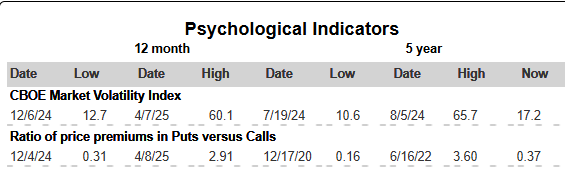
  • Volatility Index:  NEUTRAL. Volatility has been volatile. The “VIX” is now 17, the same as two weeks ago. The index is also known as the “Fear Index.” It is considered a contrarian indicator and therefore viewed as bullish as it rises indicating investors are becoming more fearful. The VIX:
502fdd07-23bc-47a7-ad04-cc3b3f2387db image
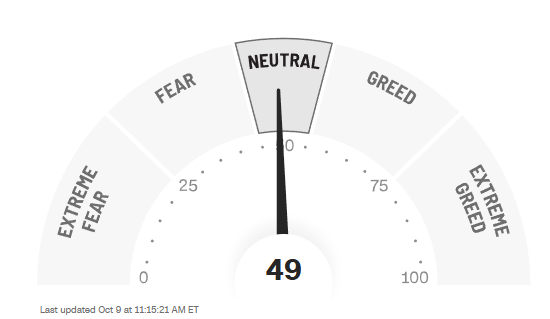
  • Fear / Greed Index: BEARISH.  Investors are driven by two emotions: fear and greed. Too much fear can create a condition of oversold/ undervalued stock prices. Too much greed can result in overbought/overvalued stock prices. The AAII Investor Sentiment Index is now neutral.   BE FEARFUL WHEN OTHERS ARE GREEDY. At 49, the Fear & Greed Index is up from 57 two weeks ago.

CLICK VIDEO FOR MORE ON THE “FEAR & GREED INDEX”

How CNNMoney’s Fear & Greed Index works

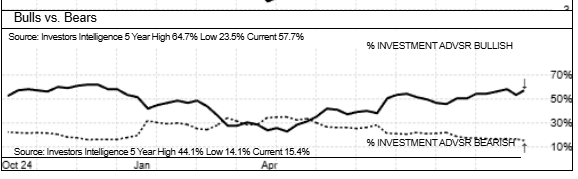
  • Bull / Bear Barometer:  BEARISH. This secondary market indicator should also be viewed with a contrarian perspective. As of yesterday, according to the latest survey of stock market newsletter writers by Investor’s Intelligence, the bullish tally is 57.7%,  the same as two weeks ago. The bears are 15.4%, down from 17% two weeks ago. Consider this a contrarian indicator because the crowd is often wrong at market tops and bottoms. In other words, extreme bullishness has been seen near several market tops in the past, while extreme bearishness has been seen at market bottoms.
  • Put / Call Ratio: BEARISH. The ratio of put-to-call options is 0.37, down from 0.66 two weeks ago. The put-call ratio tracks the mood of what options investors are doing, not just saying. They typically buy puts if they think a stock will decline and calls if they think it will rise. If they’re buying lots of puts, they see the market declining. And if they’re loading up on calls, they’re generally bullish. Historically, market bottoms occurred when the reading spikes to 1.2 or more. Market tops are often made when the reading is 0.6 or less. Note how reliable this is with respect to the February record low coinciding with the market high. Keep in mind this is also a contrarian indicator.

ECONOMIC UPDATES

Global Economic Indicators & Analysis:

Government Shutdown Delays Many Economic Report Releases.

POSITIVE INDICATORS

Pending Home Sales Up: Pending home sales jumped in August to a five-month high as some buyers returned to the market on the back of a big drop in mortgage rates. Contract signings in the U.S. rose 4% in August from the previous month, according to a monthly index released Monday by the National Association of Realtors last Monday. Pending home sales rose to the highest level since March 2025. Sales are also up 3.8% from the same month a year ago. Pending home sales reflect transactions where the contract has been signed for an the sale of an existing home, but the sale has not yet closed. Economists view it as an indicator for the direction of existing-home sales in subsequent months. The pace of pending home sales exceeded expectations on Wall Street. The median forecast was for a flat reading in August, based on a survey of economists conducted by Dow Jones Newswires and the Wall Street Journal.

WEAK INDICATORS

Jobs Market Down: Call it a frozen U.S. jobs market. Businesses aren’t filling as many open jobs, and fewer people are quitting for fear they won’t find other work. That’s what’s the government’s job-openings report has been saying for months, and that’s the main takeaway from the August report, too, released last Tuesday.. Job openings were unchanged at 7.2 million in August, remaining at the second-lowest level since the pandemic. The rate of hiring in the private sector fell a tick to 3.5% and matched the lowest level in almost 15 years if the pandemic era is excluded. The percentage of people quitting jobs in the private sector also slipped a notch to 2.1% and matched a post recession low. The biggest bright spot in the report: that most companies aren’t resorting to mass layoffs.

ADP Employment Down: Privately run businesses eliminated jobs in September for the third time in four months, ADP said, in another sign of emerging weakness in the labor market that alarmed the Federal Reserve enough to cut interest rates two weeks ago. The private sector culled 32,000 jobs last month, according to ADP, the nation’s largest processor of payroll checks. Monthly employment has fallen three times since June to mark the worst stretch for the labor market since the pandemic. The ADP employment report is likely to be the only one investors see this week after a government shutdown began after midnight, September 30. The official U.S. jobs report produced by the Bureau of Labor Statistics is expected to be delayed during the government shutdown.

Consumer Confidence Down: Consumer confidence fell sharply in September on growing worries about the labor market. The consumer-confidence index dropped to 94.2 in September from a revised 97.8 in the prior month, the Conference Board said last Tuesday. This is the lowest level since April. Economists polled by the Wall Street Journal had forecast the index to slip to 96.0 in September from the initial estimate of 97.4 in August. Consumers’ assessment of the availability of jobs fell for the ninth straight month. A measure that looks at how consumers feel about the economy right now fell 7 points to 125.4. That’s the largest drop in a year. A confidence gauge that looks six months ahead dropped by 1.3 points to 73.4. Since February, the expectations index has been below the threshold of 80, which has traditionally been seen as a signal of recession. Economists focus on labor-market conditions by measuring the spread between the percentage of consumers who think jobs are plentiful and the percentage who think jobs are hard to get.

Manufacturing PMI Down: Output and new order books expand at softer rate Tariffs continue to hit exports and drive costs higher. Selling price inflation drops to lowest level since January. Production growth slows in September amid ongoing tariff disruptions. A solid, but nonetheless slower, improvement in US manufacturing sector operating conditions was signaled by September’s S&P Global PMI® data. The latest survey showed a weaker gain in production, while new order book growth softened as tariffs continued to weigh on exports. While firms sought to pass on higher supplier costs to clients, competitive pressures and signs of faltering demand meant output charge inflation softened to an eight month low. The headline index from the report, the seasonally adjusted S&P Global US Manufacturing Purchasing Managers’ Index™ (PMI®), recorded 52.0 in September. That was down from 53.0 in the previous month and therefore signaled a weaker rate of expansion of the manufacturing economy.

ISM Manufacturing Down: The industrial side of the U.S. economy contracted in September for the seventh month in a row, a new survey showed last Friday, as companies struggled to cope with high tariffs, rising prices and reduced demand from customers. Most manufacturers have responded by scaling back production plans and reducing employment to contain costs, according to a survey produced by the Institute for Supply Management. The ISM manufacturing index inched up to 49.1% in September from 48.7% in the prior month. Any number below 50% signals contraction.

ISM Services Down: The Institute for Supply Management said last Friday that employment contracted in the service sector for the fourth straight month in September. The service sector, which employs the most Americans (comprising about four jobs in five), has been more immune to tariffs than the manufacturing sector. But service companies are now also pausing hiring. The ISM’s employment barometer in the key service sector rose only slightly to a reading of 47.2 from 46.5 in the prior month. Numbers below 50 indicate contraction in the sector. Overall, activity in the sector was at a standstill in September, as the ISM service PMI slowed to 50 in September from 52 in the prior month. Economists polled by the Wall Street Journal had expected the ISM index to hold steady at 52.

Call me if you have any questions. I am always happy to help!

John J. Gardner, CFP®, CPM®.AIF®

Blackhawk Wealth Advisors, Inc.

3860 Blackhawk Rd, Ste. 160 Danville, CA. 94506

Phone: 888-985-PLAN · Email: jg@blackhawkwealthadvisors.com

BLACKHAWKWEALTHADVISORS.COM

For my Quarterly Market Focus podcast, click on the link below. I provide a review of global stock market highlights over past quarter and preview of the quarter ahead. Forward insights and perspectives are based on current financial market and economic trends with an emphasis on relevant developments in various areas from Fed policy to company earnings announcements.

LinkedIn
810c9060-6bc9-4e20-948f-60bee7c1b0be image
dc6d6594-dfce-48b0-8d69-3a27db12748d image
7d2eabf6-51c8-425f-b667-128ed7bc0dd2 image

Blackhawk Wealth Advisors is the parent corporation of Equity Research & Portfolio Evaluation and Blackhawk Asset Management. It’s Chief Investment Officer is John J. Gardner. John is a Certified Financial Planner (CFP®) and Certified Portfolio Manager (CPM®). As an AIF®, John is also an Accredited Investment Fiduciary.

CUSTOMIZED. STRATEGIC. DYNAMIC.