|
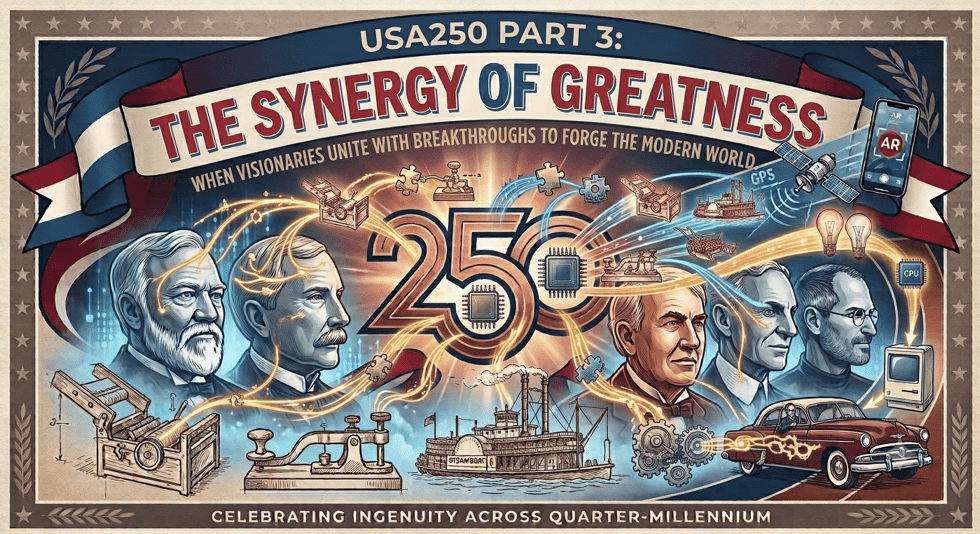
Without the cheap steel forged by Andrew Carnegie and the transcontinental rail networks consolidated by Cornelius Vanderbilt, Henry Ford’s moving assembly line would only have been gears-and-conveyor system trapped inside an isolated factory. Ford needed a cheap, reliable supply of raw steel to build his cars, and he needed a massive, interconnected rail network to ship his vehicles to dealers in every corner of the continent. Likewise, Thomas Edison’s commercial electrical grid became the literal power source that allowed subsequent inventors to dream up the washing machine, the refrigerator, and the television. Fast forward to the late twentieth century: the digital empire built by Bill Gates and Steve Jobs was entirely dependent on the microchip breakthroughs engineered in Silicon Valley decades prior.
In America, success has never been static. One generation’s ultimate achievement became the next generation’s starting baseline.
2 – The Birth of the Consumer Economy and the Rising Tide
Before the American industrial explosion, the global economy was largely a zero-sum game. Wealth was measured in land and gold; for one person to get richer, someone else usually had to get poorer. American enterprise changed that. This reined in abundance through efficiency. With business models improved by scale-driven innovations, American entrepreneurs did something revolutionary: they drove the cost of production down so low that luxuries overnight became everyday essentials. Two dynamics manifested. The first, labor dynamics, was followed by market dynamics. The labor dynamic shifted sharply from workers viewed strictly as a production cost to be minimized, to one of higher paid workers with wages to earn them the role of active consumers. Market dynamics economics swung from scarcity-driven to abundance-driven.
This synergy created the modern virtuous cycle of capitalism. When Henry Ford famously paid his workers an unprecedented $5 a day, he wasn’t simply acting out of kindness to his employees — he was expanding his market. He realized that an industrialized nation thrives when its workforce can afford to buy the very products they spend their days creating. This democratization of goods fundamentally altered the global standard of living. Indoor plumbing, refrigerated food, reliable lighting, and personal transportation ceased to be the possessions of the few. They became standard baselines of human improvement, exported from America to the rest of the civilized world.
3 – The Great Intangible: Freedom to Fail
I have often had the thought, “Why America?” Why did the modern world’s most disruptive commercial revolutions persistently originate in America? Looking across the globe over the last 250 years, certainly other nations had brilliant scientists, vast natural resources, and powerful militaries. Perhaps the answer is in the intangible: freedom to fail. In the “Old World”, failure was frequently met with societal disgrace, permanent financial ruin, or even debtor’s prison. The American experiment pioneered a radically different cultural and legal perspective. Through the evolution of limited liability corporations and robust bankruptcy laws, America separated personal ruin from business risk. America essentially treats failure as a tuition payment. There’s an experience – there’s a lesson learned. I have failed. Many well known American business people, leaders and visionaries have failed. I call it “going from failing to prevailing.” Did you know Henry Ford went completely bankrupt before he ever found success with the Ford Motor Company. And Thomas Edison failed thousands of attempts on his lightbulb filament invention.
The Next 250 Years: More Ingenuity
American ingenuity will not end with the USA250 milestone. Today, a new generation of American entrepreneurs is standing on the digital and information platforms built over the last fifty years. They are utilizing the internet, cloud computing, and satellite networks to pioneer artificial intelligence, commercial space exploration, biotechnology, and clean energy grids. The core engine of the American experiment remains exactly the same: an unshakeable belief that human ingenuity, operating in an environment of radical freedom, can solve any problem, conquer any distance, and build a brighter tomorrow. If the last 250 years have taught us anything, it is that the best way to predict the future is to give an American entrepreneur the freedom to invent it. Charles Kettering said, “Our imagination is the only limit to what we can hope to have in the future”.
Here’s to the next 250, America! HAPPY USA 250!
John
|