ERPE Excerpts 4.9.26 Follow-Through Day

Bi-MONTHLY MARKET ANALYSIS &
ECONOMIC UPDATES
April 9, 2026
Follow-Through Day
Buy low, sell high. All investors know that’s the profit plan. The logic should also include buy early, not late. No faulting the reasoning in that plan, but it is easier said than done. A risk reducing approach to investing early (and therefore low) is through a technical analysis indicator known as a “follow-through day”. One of these occurred yesterday. A follow-through day is when the a major stock index delivers a strong gain in volume greater than the previous session after a new rally attempt is underway. The percentage gain required is usually 1%, although in more volatile stock markets a gain of 1.25% is better. This ideally happens within 4 -7 trading days of the new rally attempt. The longer the follow-through day takes the less reliable the rally confirmation is.
A Stock Market Follow-Through Day
Following a significant market decline, an attempted stock market rally begins when a major index closes higher than the previous session and on higher volume. The stock market rallied powerfully last Thursday and closed near session highs. The major indexes all soared near 3% or more and volume was high. It was first day of a new rally attempt. It was an impressive day for the Nasdaq which surged almost 4%, which helped recover some of the nearly 14% heavy loss since late January highs. Though tempting to react with the desire to buy low (and early), that day was just a rally attempt – day one, not the ideal time to buy. New bull rallies can only begin this way. The rally attempt either fails or it is confirmed. If in the ensuing trading sessions the previous (pre -rally day) low is undercut, the rally fails. Now patience and awareness is required to take note of the next rally attempt. Good news comes from days like yesterday. Big gains on heavy volume after just 4 trading days confirms the rally. We have a follow-through day.  The U.S. stock market’s signaled a bullish trend change yesterday: Confirmed Uptrend. In the chart above you can see the rally attempt day on March 31, and you can see the powerful gap up day today – classic example of a follow-through day. Big gains in both price and volume (red lines are down day action and blue are up).
With all the criteria boxes checked, the follow-through day is our green light. However, most people forget that a green light does not mean “hit the gas.” A green light means, “if you can proceed safely, it’s now your turn.”
Every great bull market in history has started with a rally attempt. But until the rally is confirmed with a strong price and volume follow-through day, all you have is an attempt. Understand that though while no bull market has started without a follow-through day, not all follow-through days become bull markets. For the earliest indications that the stock market is about to launch into a new convincing uptrend, look no further than the follow-through day.
Because not every follow-through results in a sustained uptrend, investors need to gauge their level of exposure in the days and weeks that come after this signal. Remember, you don’t jump on the gas as soon as the light turns green…. Caution first.

TAKING PERSPECTIVE…

Proper Perspective:  In our hectic and often hard to comprehend world, it is very easy to lose perspective. You may agree it is sometimes difficult to see the big picture. The media often doesn’t help with this, but unfortunately instead encourages us to see things in a most negative light. Here is hopefully a pause to gain positive perspective.
Famous Quote For Today:  “The war is over – the rebels are our countrymen again.”
~~Ulysses S. Grant, 1865
Today in History – On this day in 1916, Germans launched attack on a hill defended by the French, named Le Morte Homme, to outflank their front lines.

MARKET ANALYSIS

INDICATORS OF INTEREST:
  • Market’s Current Signal: Confirmed Uptrend.  Analysis of the stock market over 130 years of history shows we can view it in terms of three stages -market in uptrend, uptrend under pressure and market correction.  Since the 1880’s, this perspective has led to investment out-performance relative to market indexes. This is due to trend analysis which determines risk reducing, return enhancing market entry and exit points.
The U.S. stock market’s current signal indicates the market is in Confirmed Uptrend. This trend change was triggered yesterday, confirming a rally attempt on March 31.
Here are key market levels as of Monday, April 6:
Recapping Last Week
Despite the lack of a clear off ramp to the war in Iran, U.S. equity indices rallied sharply in volatile trading, posting their first weekly gain since the conflict began. The Nasdaq Composite index jumped nearly 4.5%, while the S&P500 and Russell 2000 each rose more than 3%. Crude oil futures surged by 11.5% on Thursday after President Trump vowed to strike Iran more aggressively, while Iran’s armed forces warned the U.S. and Israel of further retaliatory attacks in response. In contrast to stocks, which reversed from steep losses at Thursday’s open, oil was little moved by reports of Iran working with Oman to develop a collaborative framework to monitor
traffic in the Strait of Hormuz. Ten of eleven U.S. sectors finished higher, with energy (-5.3%) the sole loser even as oil prices climbed. Gold and silver faded at week’s end, but each gained around 4%. U.S. Treasury yields eased as investors priced in the increasing likelihood of a global economic slowdown triggered by the war in the Middle East. Fed Chair Powell’s comments also contributed to the fall in yields—he said the central bank has little control over supply shocks that might be caused by the surge in oil prices, but that longer-term inflation expectations are not yet rising. Last week’s economic data suggested that the U.S. remains on solid footing—for now. March’s non-farm payrolls, released on Friday while U.S. equity markets were closed, rebounded more than expected with 178,000 jobs added. The unemployment rate fell to 4.3%. Other labor market data presented a mixed picture: private payrolls rose by 62,000, while job openings fell more than forecast and hiring dropped to the lowest level in six years. Layoffs at technology companies continued to increase, with artificial intelligence advancements cited as a main driver. The Commerce Department continued to catch up on data delayed by last year’s government shutdown, announcing that U.S. retail sales increased 0.6% in February. ISM manufacturing PMI lifted to 52.7 in March, the highest reading since August 2022. Part of the rise was due to increasing delivery times, which typically occur in a strong economy but in the current environment may indicate supply chain disruptions. The prices paid measurement jumped to 78.3 from 70.5. The Conference Board’s consumer confidence indicator, which generally focuses on labor market conditions rather than the cost of living, rose to 91.8 last month.
Overseas, some 40 countries were engaged in virtual talks on Thursday, exploring ways to restore navigation in the Strait of Hormuz. Eurozone inflation spiked to 2.5% YoY in March, up from 1.9%. The rise was almost entirely due to rising energy prices. Manufacturers faced soaring input costs and supply chain disruptions, forcing them to raise prices. Germany’s top economic institutes cut their growth forecasts for this year and next and raised inflation projections. In Japan, core consumer prices in the country’s capital rose 1.7% YoY in March, a figure analysts expected to rise in the coming months. Japanese manufacturers expressed their highest level of optimism in more than four years, according to the Tankan survey. Finally, China’s official PMI surveys rose more than expected last month as production and new orders expanded.
Current View
As noted with my opening comments in today’s Excerpts, the stock market’s trend is now Confirmed Uptrend. This signal was a bullish trend change in the market yesterday with a convincing follow-through day.
Here’s my 2026 OUTLOOK.
  • Industry Group Strength:  BEARISH. As of yesterday, 97 out the 197 groups I monitor are up year-to-date. 100 are down.
  • New Highs vs. New Lows: BULLISH.  In yesterday’s session, there were 297 new 52-week highs and 38 new 52-week lows.
  • Dow Dividend Yield:  BEARISH. The current yield for the Dow Jones Industrial Average is 1.83%. The 10-year Treasury now 4.27%.
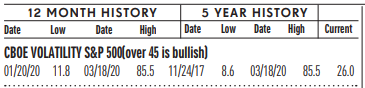
  • Volatility Index:  NEUTRAL. Volatility has been volatile. The “VIX” is now 20. This is down from 26 two weeks ago. The index is also known as the “Fear Index.” It is considered a contrarian indicator and therefore viewed as bullish as it rises indicating investors are becoming more fearful. The VIX:
502fdd07-23bc-47a7-ad04-cc3b3f2387db image
  • Fear / Greed Index: BULLISH.  Investors are driven by two emotions: fear and greed. Too much fear can create a condition of oversold/ undervalued stock prices. Too much greed can result in overbought/overvalued stock prices. The AAII Investor Sentiment Index is now neutral.   BE FEARFUL WHEN OTHERS ARE GREEDY. At 36, the Fear & Greed Index is up down 19 two weeks ago.
CLICK VIDEO FOR MORE ON THE “FEAR & GREED INDEX”
  • Bull / Bear Barometer:  BULLISH. This secondary market indicator should also be viewed with a contrarian perspective. As of yesterday, according to the latest survey of stock market newsletter writers by Investor’s Intelligence, the bullish tally is 33.3%, down from 39.3% two weeks ago. The bears are 27.8%, up from 25% two weeks ago. Consider this a contrarian indicator because the crowd is often wrong at market tops and bottoms. In other words, extreme bullishness has been seen near several market tops in the past, while extreme bearishness has been seen at market bottoms.
  • Put / Call Ratio: NEUTRAL. The ratio of put-to-call options is .90, down from 0.95 two weeks ago. The put-call ratio tracks the mood of what options investors are doing, not just saying. They typically buy puts if they think a stock will decline and calls if they think it will rise. If they’re buying lots of puts, they see the market declining. And if they’re loading up on calls, they’re generally bullish. Historically, market bottoms occurred when the reading spikes to 1.2 or more. Market tops are often made when the reading is 0.6 or less. Note how reliable this is with respect to the February record low coinciding with the market high. Keep in mind this is also a contrarian indicator.

ECONOMIC UPDATES

Global Economic Indicators & Analysis:
POSITIVE INDICATORS
Jobs Market Up: The U.S. added a greater-than-expected 178,000 jobs in March and the unemployment rate fell a tick to 4.3% — signs that the labor market is holding firm even as the economy undergoes another spasm of uncertainty tied to the Iran war. The increase in employment March, the biggest in 15 months, was padded by the return of 31,000 striking nurses. Better weather last month may have also helped.
Manufacturing Sector Up: The Institute for Supply Management’s survey of manufacturers inched up to 52.7% in March from 52.6% in the prior month, according to last Wednesday’s report. It was the highest reading since August 2022. American manufacturers grew in March at the fastest pace in 2½ years, by one measure, but the Iran war added fresh uncertainty and threatened to boost inflation just as the effects of the original Trump tariffs were fading.
Consumer Confidence Up: The U.S. Consumer Confidence Index, released monthly by The Conference Board, edged up to 91.8 in March 2026, though it remains on a downward trend, reflecting cautious consumer sentiment. This report was released last Tuesday. It measures optimism regarding income, business, and labor conditions to gauge future spending. While high readings suggest economic growth, low sentiment can signal reduced spending.

WEAK INDICATORS

Jobless Claims Up: The number of seasonally adjusted initial jobless claims rose by 16,000 in the last week, landing at 219,000, the Department of Labor said in its report published today. The 4-week moving average saw a weekly increase of 250 to reach 208,000. The advance seasonally adjusted insured unemployment rate for the week ending March 28 remained at 1.2%. The advance number for seasonally adjusted insured unemployment in that week decreased by 38,000 to 1,794,000. Meanwhile, the 4-week moving average declined by 13,250 to 1,823,250.
Service Sector Down: The largest part of the economy grew a bit slower in March as the Iran war drove up costs and companies reacted by reducing employment, suggesting a rockier path for the U.S. until the conflict ends. A survey of service companies such as banks, retailers and restaurants slipped to 54% in March from 56.1% in the prior month, the Institute for Supply Management said Monday. The February reading was the highest in 3½ years. Still, any number above 50% is a sign that business is growing. The index has topped that key threshold for 21 months in a row.
Durable Goods Orders Down: Escalation in the Iran war could stoke elevated factory-gate inflation further. Orders for durable goods intended to last three years fell 1.4% in February, according to the Commerce Department’s report Tuesday.
PCE Up: The personal-consumption price index, the Fed’s preferred price gauge, rose by 0.4%, matching the forecast of economists yesterday. Shortly before the start of the Iran war, a key measure of U.S. inflation rose at an excessive pace for the third month in a row, underscoring the latest challenge facing the Federal Reserve as it tries to squelch stubborn price pressures. The rate of inflation in the 12 months that ended in February held steady at 2.8%, the same as in the prior month. Yet only last spring, the PCE inflation rate had sunk to a post-pandemic low of 2.3%. Stubborn inflation will also prevent the Fed from cutting interest rates, at least for the next few months. The Fed views the PCE index as the most accurate barometer of U.S. inflation trends.
Call me if you have any questions.  I am always happy to help!
John J. Gardner, CFP®, CPM®.
Blackhawk Wealth Advisors, Inc.
Phone: 888-985-PLAN · Email: jg@blackhawkwealthadvisors.com