ERPE Excerpts 2.12.2026 The Great Handoff

The Great Handoff
The 493 Take The Lead From The 7
Last Friday was an historical day for the American stock market. The excitement was the Dow Jones Industrial Average (the Dow) closing above 50,000 for the first time in its 130 year existence. The party hats came out on CNBC – the stock channel – as traders on the floor of the New York Stock Exchange wore caps with 50,000 on them. That truly was a milestone. It got me thinking of how high the blue-chip stock index has climbed since I started my career in 1984 when the Dow was about 1,100….
This milestone achievement has been more difficult for the major U.S. stock index; the S&P 500. It has been creeping slowly but surely towards 7,000, its next milestone level and new all time closing high. You can’t fault its effort. The S&P 500 has steadily inched towards 7,000 since its first close ever above 6,000 last June. However, it has experienced a noticeable stall in its advance since climbing above 6,900 in late October. In a word, the major index has gone sideways since then. The index even rose above 7,000 on January 28, scoring an intraday high of 7,002 but closing below 7,000 that day and then began about a 3% fall through February 5 when it was as low as 6,780 intraday. It has to close above the target to make the history books. Its now back to within 1% of 7,000 and is likely to close above it and achieve that milestone any day now. So, why has the S&P 500 run into so much resistance around 7,000? The reason isn’t about the number. Its about rotation. There has been a shift in market leadership. I call it the Great Handoff. What has happened since early last fall is a rotation out of what is commonly referred to as the “Magnificent 7” to the “Other 493”. The S&P 500’s relative strength has shifted from those seven mega-cap, “Big Tech” stocks to the rest of the “market basket” – the remaining 493 stocks. We are currently witnessing one of the most aggressive rotations in recent market history. The macro view offers a quick clue of the rotation underway. The Dow has gained about 3.5% while the Nasdaq has lost 1.5% so far this year, through yesterday. The Russell 2000 (Small-Caps) recently completed a historic 15-session winning streak against the S&P 500—the longest such run since 1996. Year-to-date energy, materials, and industrials are the leading sectors within the S&P 500. They are all up over 12%, while the technology sector is down nearly 2%. This is a scenario I call the return to the “soups, soaps, and cereals”. Here’s how that trade currently looks year-to-date: Campbell’s Soup is +4%, Proctor & Gamble +11% and Post Holdings (cereal) +12%. The Big 3 of the Mag 7 are down ytd: Amazon -12%, Alphabet (Google) -1% and Microsoft -17%.
That clear market rotation or leadership shift is well expressed by the passing of a baton. Only, in this market’s case the baton is not handed off as runners do with a teammate, but is taken by sectors as the flow of money in the market determines. This results in downtrends within the uptrend. Or, rolling bear markets within a bull market. Both sound counterintuitive but do happen and explain the S&P 500’s sideways movement. For example, currently the software industry within the Tech sector is in a bear market as it is down nearly 22% ytd. The Materials and Energy sectors are rallying in their own bull markets. The net effect for S&P 500 index has been flat. This also speaks to how the major index is calculated. The “weighted” bias to the index results in it being impacted – both good and bad – by the Mag 7 stocks because of the enormous, muti-trillion dollar size. What is bullish and likely to carry the S&P 500 above and beyond its next milestone is the strength of the 493. However, because the “7” have such an inordinate weighting on the index, the 493 will have to continue on their current upward trend. As we have seen, though, from the 7, a bull market for the S&P 500 is easier to achieve if they lead the way.
My MoneyShowTop Picks for 2026 are consistent with this macro trend.

TAKING PERSPECTIVE…

Proper Perspective:  In our hectic and often hard to comprehend world, it is very easy to lose perspective. You may agree it is sometimes difficult to see the big picture. The media often doesn’t help with this, but unfortunately instead encourages us to see things in a most negative light. Here is hopefully a pause to gain positive perspective.
Famous Quote For Today:  “We have faith that future generations will know that here, there came a time when men of good will found a way to unite.”
~~ Franklin D. Roosevelt, 1943
Today in Markets History – On this day in 1997, the S&P 500 closed above the 800 mark for the first time, having doubled in less than six years.

MARKET ANALYSIS

INDICATORS OF INTEREST:
  • Market’s Current Signal: Confirmed Uptrend.  Analysis of the stock market over 130 years of history shows we can view it in terms of three stages -market in uptrend, uptrend under pressure and market correction.  Since the 1880’s, this perspective has led to investment out-performance relative to market indexes. This is due to trend analysis which determines risk reducing, return enhancing market entry and exit points. The U.S. stock market’s current signal indicates the market is in Confirmed Uptrend. That officially happened April 22 and is still intact. This has been the fastest market rebound from a bear market low in history. The uptrend is remains. October 12, 2025 was the 3rd anniversary of this bull market. As of today, though, an impactful industry group in the market is in bear market territory. Software. This has spread to further sector shifts and a major market rotation.
The Stock Market Trend: Confirmed Uptrend. The stock market powered higher after the bottom of last year’s Tariff Tantrum over Trump’s Liberation Day, Tuesday, April 22. Since then the Nasdaq and S&P 500 have remained in confirmed uptrends. In late June the major stock market indexes reclaimed levels set in late February and significantly above the pre-“Liberation Day” level. There were 38 new highs in 2025 for the SP 500. Volatility has since spiked in the U.S. equity market – notably starting with a trend breaker session on November 20. That quickly turned higher again. As is the new norm, the BTD (buy the dip) behavior resulted in a reversion back to a bullish trend in the ensuing days. While the SP 500 gained again in the last quarter of the year, it was noticeably flat as the last three month closing levels for the broad index were essentially unchanged. Convincing stock market strength in the first month of the new year showed the bull on Wall Street is alive – but well is the increasing question. Today’s slip in software stocks has caused a quick give back of a good bit of the year’s gains so far. A market rotation in evident.
Here are key market levels as of Monday, February 9:
Recapping Last Week
A sharp three-day selloff hit risk assets as investors reassessed some of the potential economic impacts from artificial intelligence adoption. The Nasdaq Composite index bounced back more than 2% on Friday but still ended the week lower by 1.8%, while the S&P500 was flat. Smaller companies and equal-weight indices continued to outperform as the S&P400 MidCap 400 jumped 4.4%, and the Russell 2000 and the S&P500 Equal Weight each gained more than 2%. Sector performance favored cyclicals like basic materials (+4.5%), energy (+4.3%), and industrials (+4.7%), while consumer staples soared 5% after Pepsico and Colgate-Palmolive saw positive reactions to their earnings reports. Technology slid 2% and the software sub-index plunged 9% after Anthropic unveiled an AI tool viewed as a potential replacement for widely used software products in the legal and finance fields. Shares of Advanced Micro Devices sank midweek after delivering a lackluster sales forecast, while Amazon tumbled on Friday after forecasting $200 billion in capital expenditures this year, a 50% increase YoY. Precious metals remained highly volatile, with silver sinking to $63.90 and ultimately ending the week lower by 9% at $77. Gold finished with a small gain after trading in a wide range. Fears of another “crypto winter” added to investors’ anxiety after Bitcoin cratered by 30% to $60,000 before recovering about one-third of the losses on Friday. Turning to economic news, the partial U.S. government shutdown ended on Tuesday, and though it was brief, it pushed the release of January’s non-farm payrolls report to February 11. Other data reflected a labor market that continues to soften. Private payrolls increased by just 22,000 in January and wage growth slowed. Job openings in December fell to the lowest level since 2020 while layoffs jumped above 100,000 last month. However, Amazon and UPS accounted for most of the cuts, and although weekly jobless claims increased more than expected in the last week of January, the underlying trend remained stable. U.S. Treasury yields fell in reaction to the weaker jobs data while bond prices also caught a bid from investors seeking shelter from volatility in risk assets. ISM Manufacturing PMI moved into expansion territory for the first time in a year, but survey respondents were still wary of tariffs and rising raw material prices. Consumer sentiment improved at the start of February as one-year inflation expectations plummeted half a percentage point to 3.5%, the lowest level since January 2025.
Internationally, OPEC kept oil output unchanged for March amid Middle East tensions. Crude oil futures fell 3.4% in volatile trading as news of talks to de-escalate friction between the U.S. and Iran were weighed against incidents in the Strait of Hormuz. The European Central Bank left rates unchanged and offered no insight into its next move. Inflation in the Eurozone dipped to 1.7% YoY in January while core CPI edged down to 2.2%. The Bank of England also kept rates on hold in a closer than expected vote, suggesting differing opinions on how much evidence is needed that inflation is trending lower. The Reserve Bank of Australia became the first to raise rates this year, citing persistent inflation pressures and a stronger economy running up against capacity constraint
Current View
No new rate cuts was no big deal yesterday. But there was almost a big deal yesterday: The S&P 500 almost closed above 7,000 for the first time ever. The major index hit an intraday high of 7,002, but couldn’t hold the record high and closed slightly lower. The real big news of the day, and in the days and weeks ahead, is earnings. Three mega-cap tech stocks announced their quarterly earnings after the close yesterday and have triggered a sharp sell-off today. While Tesla and Meta gave the market reasons to buy the stocks, Microsoft offered a disappointing report and has so far been a major catalyst behind the selling pressure – especially in the software sector. The computer software industry group is now in a bear market. This is the most significant crack in the overall bull stock market that began in October of 2022. The software stock group is now down more than 20% from its previous high and on pace for the worst month since 2008.
Small caps lagged in the stock market yesterday — but not by much — as Wall Street weighed a stronger-than-expected January jobs report. Distribution days have clearly started to cluster on the Nasdaq, with five over the past 10 trading sessions. The stock market can hold up amid signs of institutional selling. But a flurry of distribution days has marked the start of every single market correction throughout history. So it’s important to monitor them, along with the action of leading growth stocks. As note above, their has been a meaning market trend change as leadership rotates from the “Mag 7” to the “Other 493”.
Here’s my 2026 OUTLOOK.
  • Industry Group Strength:  BULLISH. As of yesterday, 149 out the 197 groups I monitor are up year-to-date. 48 are down.
  • New Highs vs. New Lows: BULLISH.  In yesterday’s session, there were 723 new 52-week highs and 234 new 52-week lows.
  • Dow Dividend Yield:  BEARISH. The current yield for the Dow Jones Industrial Average is 1.74%. The 10-year Treasury now 4.12%.
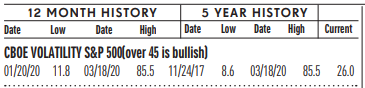
  • Volatility Index:  NEUTRAL. Volatility has been volatile. The “VIX” is now 20, up from 18 two weeks ago. The index is also known as the “Fear Index.” It is considered a contrarian indicator and therefore viewed as bullish as it rises indicating investors are becoming more fearful. The VIX:
502fdd07-23bc-47a7-ad04-cc3b3f2387db image
  • Fear / Greed Index: NEUTRAL.  Investors are driven by two emotions: fear and greed. Too much fear can create a condition of oversold/ undervalued stock prices. Too much greed can result in overbought/overvalued stock prices. The AAII Investor Sentiment Index is now neutral.   BE FEARFUL WHEN OTHERS ARE GREEDY. At 49, the Fear & Greed Index is up down 58 two weeks ago.
CLICK VIDEO FOR MORE ON THE “FEAR & GREED INDEX”
  • Bull / Bear Barometer:  BEARISH. This secondary market indicator should also be viewed with a contrarian perspective. As of yesterday, according to the latest survey of stock market newsletter writers by Investor’s Intelligence, the bullish tally is 59.6%, down from 61.5% two weeks ago. The bears are 15.4%, same as two weeks ago. Consider this a contrarian indicator because the crowd is often wrong at market tops and bottoms. In other words, extreme bullishness has been seen near several market tops in the past, while extreme bearishness has been seen at market bottoms.
  • Put / Call Ratio: NEUTRAL. The ratio of put-to-call options is 0.79, about the same as 0.71 two weeks ago. The put-call ratio tracks the mood of what options investors are doing, not just saying. They typically buy puts if they think a stock will decline and calls if they think it will rise. If they’re buying lots of puts, they see the market declining. And if they’re loading up on calls, they’re generally bullish. Historically, market bottoms occurred when the reading spikes to 1.2 or more. Market tops are often made when the reading is 0.6 or less. Note how reliable this is with respect to the February record low coinciding with the market high. Keep in mind this is also a contrarian indicator.

ECONOMIC UPDATES

Global Economic Indicators & Analysis:
POSITIVE INDICATORS
Jobless Claims Down: Initial jobless claims declined by 5,000 to 227,000 in the last week, the government said today, nudging them back down toward recent lows. New filings had jumped in the last week of January, but the increase was tied to Winter Storm Fern. Many people were unable to get to work, government offices were temporarily closed and some recently laid-off workers waited until the weather improved to file for benefits. The number of people already collecting unemployment benefits, known as continuing claims, rose by 21,000 to 1.85 million. These claims had risen steadily for several years and had almost reached a post-pandemic high of 2 million last fall, but they have since tapered off. That’s another sign a fragile labor market is starting to regain some health. The labor market is not as good as a surprisingly positive January employment report seems to suggest, but it might be entering recovery mode as 2026 gets under way. The situation couldn’t get much worse than it did in 2025. The U.S. only added 181,000 new jobs, the smallest increase in any year the economy was not in recession since 2003.
Jobs Market Up and Unemployment Down: The U.S. added 130,000 jobs in January to mark the biggest gain in 13 months, but the increase was likely inflated by a shift in holiday hiring patterns in an improving but still-fragile labor market. Even better, the unemployment rate fell for the second month in a row to 4.3% in a good sign for the economy. Businesses created very few new jobs last year, but they also kept layoffs low. As long as most people are working, they’ll spend enough money to keep the economy expanding. “The better-than-expected job numbers for January are a bright spot in an otherwise uncertain labor market,” said Jeremy Templeman, vice president of economic and fixed-income research at Mutual of America Capital Management. Wall Street had expected a smaller gain of 55,000 new jobs. The January employment report won’t sway Federal Reserve officials to change interest rates anytime soon. It appeared to support the view the labor market has stabilized after a big swoon last year, letting Fed officials put more weight on their fight vs. stubborn inflation. The January employment numbers are seasonally adjusted. Before adjustments, the economy typically loses jobs in the first month of the year as companies let go of temporary holiday hires.
ISM Manufacturing Up: U.S. manufacturers saw a burst of new orders in January, and business grew for the first time in 11 months, but the improvement appeared tied to the start of a new year and probably doesn’t herald an end to a tariff-induced slump. The Institute for Supply Management’s survey of manufacturing jumped to 52.6% in January from 47.9% in the prior month. The reading, released Monday, was the highest since June 2022. Any number above 50% indicates business is growing — but only after a sustained run above the threshold. The survey sometimes produces strong January readings as companies restock after the Christmas shopping season. “January is a reorder month after the holidays, and some buying appears to be to get ahead of expected price increases due to ongoing tariff issues,” said Susan Spence, chairwoman of the index. Executives polled by ISM said they hope the second half of 2026 will be the start of a sustained expansion. But the leaders see plenty of difficulties in the short run as they deal with ongoing tariffs, political uncertainty and an anti-American sentiment among customers overseas.
ISM Services Up: The largest part of the economy expanded again in January, pointing to decent growth early in the new year, but businesses are still grappling with a hangover from high tariffs and finding ways to adopt artificial intelligence. A survey of service companies such as banks, retailers and restaurants was unchanged at 53.8% in January, the Institute for Supply Management said last Wednesday. Any number above 50% is a sign that business is growing. The index has topped this key threshold for 19 months in a row.

WEAK INDICATORS

Existing Home Sales Down: According to the National Association of Realtors (NAR) today, U.S. existing-home sales plunged 8.4% in January 2026 to a seasonally adjusted annual rate of 3.91 million. This is a 4.4% decline year-over-year as tight inventory and high prices continued to constrain market activity. The median existing-home price rose 0.9% from a year ago to $396,800, marking a continued trend of low inventory hindering affordability.
Job Openings Down: The number of job openings in December fell to the lowest level in eight years, excluding the COVID-19 pandemic era, underscoring the fragility of the U.S. labor market in the new year. U.S. job openings dropped by 386,000 in December to 6.5 million, the government said in a report delayed by federal shutdowns. That’s the lowest total since 2017, excluding the 2020-21 time frame. New hires in December totaled 5.29 million, but they were offset by 5.25 million separations — layoffs, job quitters, retirements, deaths and so forth. The exceedingly small gap between hires and separations illustrates just how weak the labor market has gotten since last spring. The economy is barely adding net new workers. Although the report is dated, the early evidence this year suggests the labor market is still depressed. Layoffs are low, but hiring is the weakest in 15 years.
Small Business Optimism Down: The NFIB Small Business Optimism Index fell 0.2 points in January to 99.3 and remained above its 52-year average of 98. Of the 10 Optimism Index components, three increased and seven decreased. Expected real sales volume was the only component with substantial change, increasing by 6 points. The Uncertainty Index rose 7 points from December to 91. A rise in owners reporting uncertainty about whether it is a good time to expand their business was the primary driver of the rise in the Uncertainty Index. One major highlight of this report is the new NFIB Small Business Employment Index, which translates multiple jobs-related questions into one single number. Currently, this index tells a story of a balanced labor market, coming in about 1.5 points above its historical average (101.6 current vs 100 average).
Car Sales Down: Sales of new cars and trucks — a barometer for the economy — sank in January to the lowest level in three years after a major winter storm. It could be a tough year for automobile makers even after the weather gets warmer. Sales increased at an annual rate of 14.9 million units in January, down 7% from 16.1 million in the final month of 2025, according to Wards Intelligence. The figure reflected how many new vehicles would be sold in the entire year if the same number were purchased each month as were sold in January.
Call me if you have any questions.  I am always happy to help!
John J. Gardner, CFP®, CPM®.